<?xml version="1.0" encoding="utf-8"?>
<feed xmlns="http://www.w3.org/2005/Atom" xmlns:media="http://search.yahoo.com/mrss/">
    <title>Industry Report Section</title>
    <link href="https://www.onluxy.com/industry-reports-research/feed.xml" rel="self" />
    <link href="https://www.onluxy.com/industry-reports-research" />
    <updated>2026-02-14T17:56:22+08:00</updated>
    <author>
        <name>Dr. Max Langdon</name>
    </author>
    <id>https://www.onluxy.com/industry-reports-research</id>

    <entry>
        <title>AI Adaption Among HNWIs</title>
        <author>
            <name>Dr. Max Langdon</name>
        </author>
        <link href="https://www.onluxy.com/industry-reports-research/ai-adaption-emotional-firewall.html"/>
        <id>https://www.onluxy.com/industry-reports-research/ai-adaption-emotional-firewall.html</id>
        <media:content url="https://www.onluxy.com/industry-reports-research/media/posts/12/AI-Report-Cover.jpg" medium="image" />

        <updated>2026-02-14T17:28:09+08:00</updated>
            <summary type="html">
                <![CDATA[
                        <img src="https://www.onluxy.com/industry-reports-research/media/posts/12/AI-Report-Cover.jpg" alt="" />
                    The Need For An Emotional Auditor Dating has moved beyond the era of simple matchmaking. For HNWIs, the entire digital&hellip;
                ]]>
            </summary>
        <content type="html">
            <![CDATA[
                    <p><img src="https://www.onluxy.com/industry-reports-research/media/posts/12/AI-Report-Cover.jpg" class="type:primaryImage" alt="" /></p>
                <h1 class="align-center"><em>The Need For An Emotional Auditor</em></h1>
<p> </p>
<h2 class="p1"><strong> I. Summary</strong></h2>
<p class="p3">Dating has moved beyond the era of simple matchmaking. For HNWIs, the entire digital presence is also an exercise in risk management. With a continuous growth of fraud online the dating landscape requires a higher standard: the protection of people’s emotional and psychological bandwidth. As sophisticated manipulation and digital social engineering become more prevalent, the challenge online is no longer just finding a partner but identifying authenticity in an increasingly filtered world. This report explores how Luxy sees the Emotional Firewall, using AI to act as a guardian of sincerity and a shield against psychological fatigue.</p>
<p class="p2"> </p>
<p class="p3">Data conducted for this report reveals a clear shift in user priorities: members are moving away from passive verification toward active, AI-assisted emotional intelligence.</p>
<p class="p4"> </p>
<p class="p5"><strong>Top Research Findings:</strong></p>
<ul class="ul1">
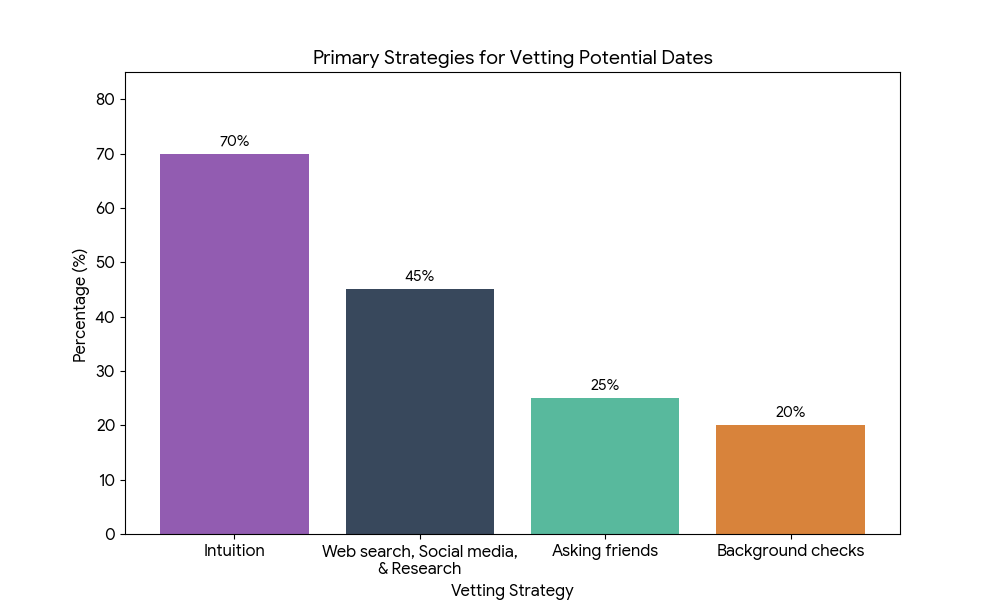
<li class="li3"><strong>The Intuition Trap:</strong> <strong>70% of HNWIs</strong> still rely on "gut feeling" for vetting, yet this is the exact vulnerability exploited by sophisticated manipulators.</li>
<li class="li3"><strong>Safety Over Convenience:</strong> <strong>78% of users</strong> stated that protection from emotional and social risk is their top priority for AI, far outweighing the desire for automated scheduling.</li>
<li class="li3"><strong>The Fear of the "Long Con":</strong> Financial risk remains high at <strong>55%</strong>, but a significant <strong>61%</strong> are specifically concerned about status-climbers using emotional manipulation to bypass traditional defenses.</li>
<li class="li3"><strong>Strategic Wingman, Not Bot:</strong> Authenticity remains king. While <strong>84%</strong> want an <strong>AI Coach</strong> to help them spot red flags and improve their own EQ, only <strong>5.8%</strong> would trust an AI to actually write their messages.</li>
</ul>
<p class="p6"> </p>
<p class="p3">In the study, we could find a 82.5% openness toward AI-assisted communication. The future of online dating is not about making the most matches, but about finding the right one, in the right way. By integrating an “Emotional Firewall”, Luxy can empower users to engage with confidence, ensuring their emotional investments are as secure as their financial ones.</p>
<p> </p>
<h2 class="p8"><strong>II. Introduction: The Psychological Risk in Elite Dating</strong></h2>
<p class="p6"> </p>
<h3 class="p5"><strong>The Context: High Stakes in the Pursuit of Quality</strong></h3>
<p class="p3">For HNWIs, the quest for a life partner is is a high-stakes search for compatibility that usually balances their personal desire with the complexities of a busy professional life. Elite platforms like Luxy have become the preferred choice for this demographic, offering a curated environment where financial vetting and profile verification act as the first line of defense. By prioritizing "quality over quantity," Luxy addresses the primary demand of the elite: a serious, streamlined path to finding a partner who matches their lifestyle and values.</p>
<p class="p3">However, the very attributes that define the HNWI lifestyle—significant assets, public visibility, and limited time—create unique vulnerabilities. In this sphere, a "bad date" is not merely a wasted evening; it is a high-cost expenditure of non-renewable time. Furthermore, the necessity of maintaining a public or professional profile means that every new interaction carries an inherent risk to trust and authenticity. For the elite, the challenge is not just finding a partner, but doing so without compromising the security of their private world.</p>
<p class="p4"> </p>
<h3 class="p5"><strong>Psychological Defense besides Financial Security</strong></h3>
<p class="p3">While dating app Luxy has historically focused on protecting its HNWIs from financial fraud, there is a growing thought that <strong>psychological risks</strong> are equally damaging. Beyond the threat of "gold-digging," HNWIs face sophisticated forms of emotional manipulation, love bombing, and misaligned intentions that can lead to profound reputational damage and emotional exhaustion.</p>
<p class="p3">Luxy introduces the concept of the <strong>"Emotional Auditor."</strong> It represents a shift in dating safety: besides passive defense (blocking known bad actors) <strong>active detection</strong> (identifying subtle patterns of manipulation in real-time) might be necessary. Just as a financial auditor scrutinizes records for inconsistencies, an emotional auditor utilizes data to flag psychological red flags that the human heart, often clouded by initial chemistry, might overlook.</p>
<p class="p4"> </p>
<p class="p4"> </p>
<h3 class="p5"><strong>The Rise of AI: Beyond Efficiency to Emotional Intelligence </strong></h3>
<p class="p3">To date, Artificial Intelligence in the consumer space has been perceived primarily as a tool for efficiency, automating tasks, scheduling, or drafting generic correspondence. However, the untapped potential of AI lies in its ability to process nuances of language, sentiment, and behavioral patterns that escape the casual observer.</p>
<p class="p3">While current AI applications in dating are often viewed with skepticism regarding authenticity issues or inaccuracies, there is opportunity to use AI as a sophisticated layer of emotional intelligence. By analyzing communication styles and identifying coercive or inconsistent patterns, AI can serve as a "firewall" for the psyche, protecting the user's emotional well-being as rigorously as a firewall protects their data.</p>
<p class="p4"> </p>
<h3 class="p5"><strong>Report Objectives</strong></h3>
<p class="p3">This report analyzes the results of a survey conducted with 120 Luxy HNWIs to bridge the gap between technological capability and user need. Our objectives are:</p>
<ul class="ul1">
<li class="li9"><strong>To quantify the exposure and concerns</strong> of HNWIs regarding psychological and reputational risks in the modern dating landscape.</li>
<li class="li9"><strong>To gauge the appetite for AI-powered "Emotional Firewalls,"</strong> identifying where users feel the technology adds value and where they remain skeptical.</li>
<li class="li9"><strong>To explore the dual role of AI</strong>—not just as a vetting tool (an "Auditor"), but as a proactive <strong>"Emotional Intelligence Coach"</strong> that empowers users to refine their own boundaries and communication strategies.</li>
</ul>
<p class="p10"> </p>
<p class="p3">Through this lens, we examine how Luxy can lead the industry in transforming AI from a convenience into an essential guardian of the elite dating experience.</p>
<p class="p2"> </p>
<p class="p2"> </p>
<h2 class="p8"><strong>III. The Vulnerabilities of Elite Dating: Why an Emotional Firewall is Needed </strong></h2>
<p class="p3">Dating platforms are not only a pool to get to know others easily but hold asymmetric risks. While HNWIs are looking for compatibility, they simultaneously have to navigate a minefield of ulterior motives, social engineering, and potential personal brand damage. The necessity of a so called "Emotional Firewall” becomes evident<span class="Apple-converted-space">  </span>when we analyze the specific vulnerabilities of this demographic and the limitations of HNWIs current protection mechanisms. The Emotional Firewall is a proactive, AI-driven layer of psychological and strategic protection by giving additional information so the individual makes the right choices.</p>
<h3 class="p5"><strong>The Specialized Risks of the Elite Tier</strong></h3>
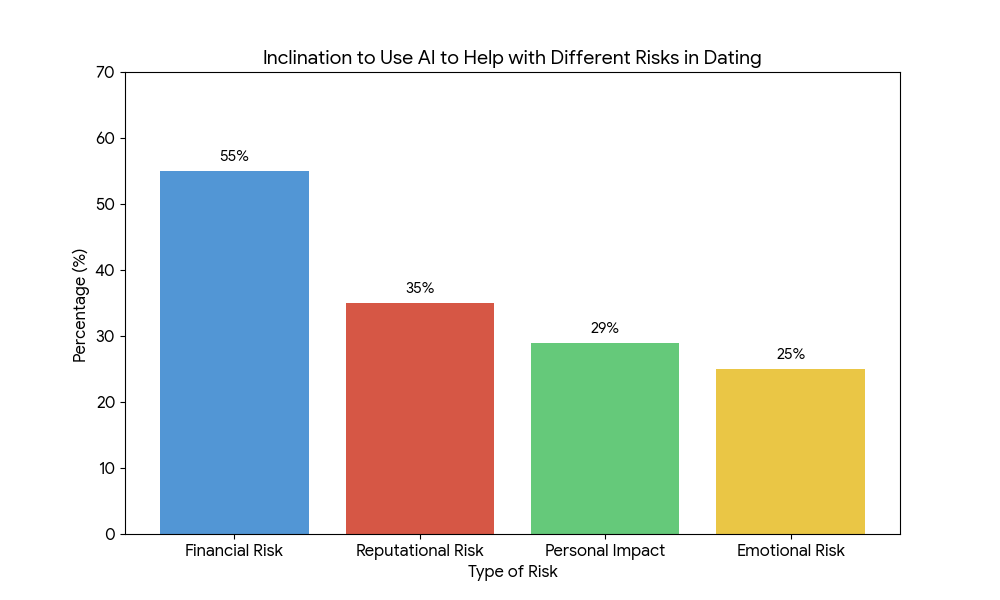
<p class="p3">The following is discussing vulnerabilities for HNWIs, and can be divided into psychological, emotional, financial and personal risks. </p>
<figure class="post__image"><img loading="lazy"  src="https://www.onluxy.com/industry-reports-research/media/posts/12/Risk-Categories.png" alt="" width="1000" height="600" sizes="(max-width: 48em) 100vw, 768px" srcset="https://www.onluxy.com/industry-reports-research/media/posts/12/responsive/Risk-Categories-xs.png 300w ,https://www.onluxy.com/industry-reports-research/media/posts/12/responsive/Risk-Categories-sm.png 480w ,https://www.onluxy.com/industry-reports-research/media/posts/12/responsive/Risk-Categories-md.png 768w"></figure>
<p class="p3"><strong>1. Financial Exploitation and the Persistence of Ulterior Motives</strong><br>The threat of financial predation remains the most significant concern for the elite. Data from Luxy members indicates that 55% of HNWIs identify financial risk as a primary worry when meeting new people online. This is further supported by the fact that approximately 61% of high-net-worth daters report being "concerned" or "very concerned" about encountering individuals driven by financial gain or status climbing. These ulterior motives often manifest as "long cons," where the manipulator integrates themselves into the victim's life so deeply that the eventual financial or social extraction is devastating.</p>
<p class="p3"><strong>2. Reputational Fragility </strong><br>For an HNWI, their reputation is often their most valuable asset. The survey data reveals that 35% of respondents view reputational risk as a major deterrent in digital dating.</p>
<p class="p3">3. <strong>Personal Brand Risk <br></strong>Nearly 30% fear the personal impact of embarrassment or social fallout. In an era of cancel culture and instant digital sharing, a single interaction with a disingenuous individual can lead to blackmail, public scandal, or the erosion of a hard-won professional legacy.</p>
<p class="p3"><strong>4. The Cost of Time and Energy</strong><br>Beyond tangible loss, the energy drain of vetting disingenuous partners is a significant vulnerability. HNWIs view time as their scarcest resource. The process of engaging with a partner only to realize weeks later that their intentions are insincere represents a massive "opportunity cost" that many are no longer willing to pay.</p>
<p class="p4"> </p>
<h3 class="p5"><strong>The Fallibility of Traditional Defenses</strong></h3>
<p class="p3">Despite these high stakes, the methods HNWIs currently use to protect themselves are largely reactive and subjective. Survey insights show a heavy reliance on gut feeling, with over 70% of HNWIs citing intuition as their primary vetting strategy. While intuition is a powerful human tool, it is easily deceived by professional manipulators who are trained to mirror the target’s values and desires.</p>
<figure class="post__image"><img loading="lazy"  src="https://www.onluxy.com/industry-reports-research/media/posts/12/Vetting-Strategies.png" alt="" width="1000" height="600" sizes="(max-width: 48em) 100vw, 768px" srcset="https://www.onluxy.com/industry-reports-research/media/posts/12/responsive/Vetting-Strategies-xs.png 300w ,https://www.onluxy.com/industry-reports-research/media/posts/12/responsive/Vetting-Strategies-sm.png 480w ,https://www.onluxy.com/industry-reports-research/media/posts/12/responsive/Vetting-Strategies-md.png 768w"></figure>
<p class="p4"> </p>
<p class="p3">Secondary strategies are equally limited:</p>
<ul class="ul1">
<li class="li9"><strong>Manual Digital Vetting:</strong> While 45% of HNWIs perform their own web and social media searches, these efforts only uncover what is publicly available. They cannot detect a "clean" profile created specifically for a sophisticated scam.</li>
<li class="li9"><strong>External Verification:</strong> Only 20% to 25% of individuals utilize formal background checks or consult friends. These methods are often perceived as too intrusive or "unromantic" for the early stages of a relationship, leaving a critical gap during the initial period of high vulnerability.</li>
</ul>
<p class="p10"> </p>
<p class="p3">Luxy’s internal database insights highlight this gap. Even with robust platform-level protections like picture verification and manual profile vetting, users frequently report unusual behavior only after an interaction has begun. Trends show that users typically unmatch or block profiles when they notice subtle red flags: an early request to move to an encrypted messaging platform, a refusal to engage in a video call, or a communication style that feels "off" or scripted. These are behavioral markers that human intuition often catches too late—after emotional or temporal investment has already occurred.</p>
<p class="p4"> </p>
<h3 class="p5"><strong>The Imperative for an AI-Driven Emotional Firewall</strong></h3>
<p class="p3">The limitations of current coping mechanisms have created a clear demand for a more sophisticated, technological solution. When asked about their priorities for AI in social interactions, a staggering 78% of HNWIs expressed that protection from social and emotional risks is either their top priority or of equal importance to convenience.</p>
<p class="p3">This is where the concept of the Emotional Firewall becomes essential. Unlike traditional vetting, which is a one-time event (like a background check), an Emotional Firewall is a continuous, AI-powered layer of protection that operates during the interaction itself. It is useful for three primary reasons:</p>
<ol class="ol1">
<li class="li9"><strong>Objective Pattern Recognition:</strong> AI can analyze linguistic patterns in real-time to detect the markers of manipulation, love bombing, or scripted communication that a human, blinded by attraction, might overlook.</li>
<li class="li9"><strong>Early Warning Systems:</strong> By identifying off-platform requests or inconsistencies in a narrative across multiple days of conversation, the AI acts as a proactive shield, flagging risks before they escalate into financial or reputational threats.</li>
<li class="li9"><strong>Preservation of Bandwidth:</strong> By automating the red flag detection process, the Emotional Firewall allows the HNWI to engage with more confidence and less defensive fatigue.</li>
</ol>
<p class="p10"> </p>
<p class="p3">In conclusion, the elite dating experience is currently defined by a high level of anxiety regarding sincerity and safety. The data shows that HNWIs are acutely aware of their vulnerabilities but lack the tools to address them objectively. The Emotional Firewall represents a necessary evolution in dating technology, moving beyond simple matchmaking to provide a sophisticated, data-driven guardian for the user’s emotional and financial well-being.</p>
<p class="p2"> </p>
<h2 class="p8"><strong>IV. User Perceptions of AI as an Emotional Auditor</strong></h2>
<p class="p3">As the concept of the Emotional Firewall moves from theoretical framework to practical application, the willingness of HNWIs to adopt AI as a social intermediary becomes a critical focal point. The transition of AI from a productivity tool to an Emotional Auditor, a system capable of parsing subtext, intent, and risk, is already underway. Data suggests that while the elite are traditionally protective of their personal spheres, a significant majority now views AI-assisted social intelligence not as an intrusion, but as a necessary evolution of digital safety.</p>
<p class="p4"> </p>
<p class="p4"> </p>
<h3 class="p5"><strong>Awareness and the Adoption Threshold</strong></h3>
<figure class="post__image"><img loading="lazy"  src="https://www.onluxy.com/industry-reports-research/media/posts/12/Usage-AI-Messaging.png" alt="" width="1000" height="700" sizes="(max-width: 48em) 100vw, 768px" srcset="https://www.onluxy.com/industry-reports-research/media/posts/12/responsive/Usage-AI-Messaging-xs.png 300w ,https://www.onluxy.com/industry-reports-research/media/posts/12/responsive/Usage-AI-Messaging-sm.png 480w ,https://www.onluxy.com/industry-reports-research/media/posts/12/responsive/Usage-AI-Messaging-md.png 768w"></figure>
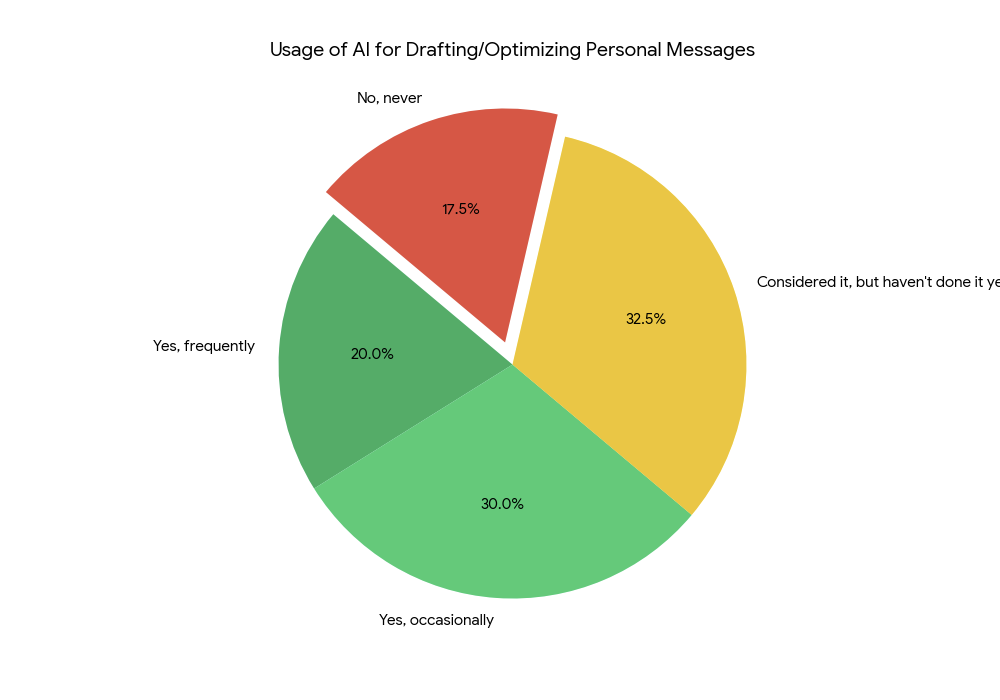
<p class="p3">Currently, already <strong>50% of HNWIs</strong> on Luxy use AI to draft, refine, or optimize their personal and professional messages, with an additional 32.5% having considered the technology but not yet implemented it. This indicates a general <strong>82.5% total market openness</strong> toward AI-assisted communication.</p>
<p class="p4"> </p>
<figure class="post__image"><img loading="lazy"  src="https://www.onluxy.com/industry-reports-research/media/posts/12/Usage-AI-Analyzing-2.png" alt="" width="1000" height="700" sizes="(max-width: 48em) 100vw, 768px" srcset="https://www.onluxy.com/industry-reports-research/media/posts/12/responsive/Usage-AI-Analyzing-2-xs.png 300w ,https://www.onluxy.com/industry-reports-research/media/posts/12/responsive/Usage-AI-Analyzing-2-sm.png 480w ,https://www.onluxy.com/industry-reports-research/media/posts/12/responsive/Usage-AI-Analyzing-2-md.png 768w"></figure>
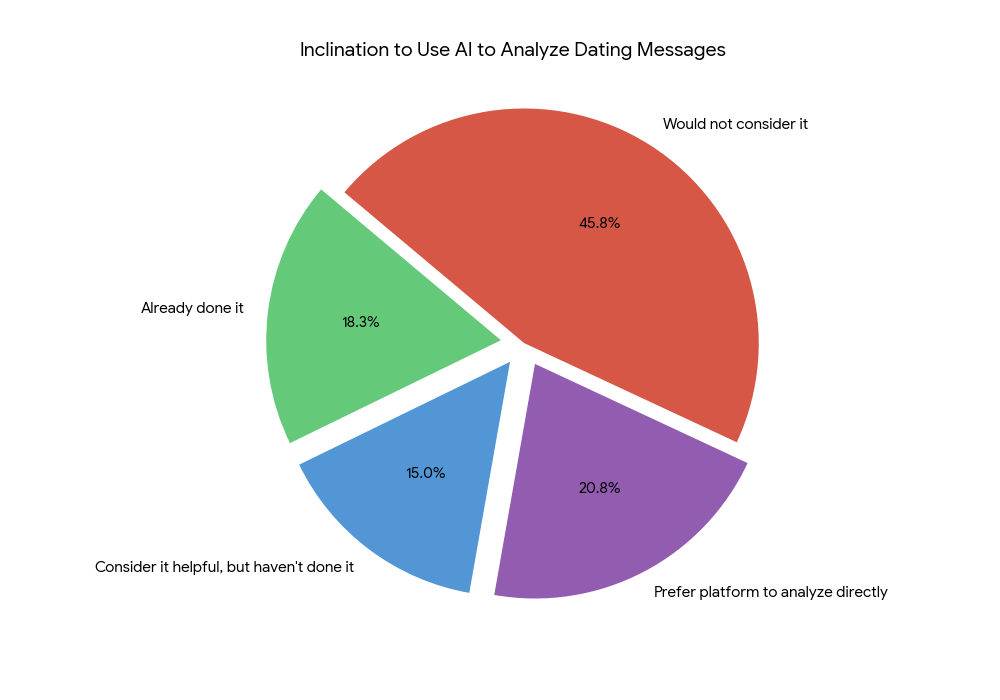
<p class="p3">However, the role of AI is shifting from active generation (writing) to passive auditing (analysis). When presented with the prospect of feeding messages from potential<span class="Apple-converted-space">  </span>matches into an AI to analyze tone and intention, 54.2% of HNWIs expressed openness to the idea. Within this group, a proactive 18.3% have already utilized AI for this purpose, while 20.8% specifically indicated a preference for the dating platform to provide this analysis directly. This suggests that for the elite user, the Emotional Auditor is most trusted when it is an integrated, seamless feature of the ecosystem rather than a third-party tool.</p>
<p class="p4"> </p>
<h3 class="p5"><strong>Specialized Detection Scenarios: What HNWIs Want to Know</strong></h3>
<p class="p3">The demand for AI auditing is driven by specific anxieties unique to the HNWI experience. The interest in "Emotional Auditing" is not generalized; it is targeted toward identifying specific threats that traditional vetting fails to catch.</p>
<figure class="post__image"><img loading="lazy"  src="https://www.onluxy.com/industry-reports-research/media/posts/12/Information-Sought-AI-Vetting.png" alt="" width="1200" height="800" sizes="(max-width: 48em) 100vw, 768px" srcset="https://www.onluxy.com/industry-reports-research/media/posts/12/responsive/Information-Sought-AI-Vetting-xs.png 300w ,https://www.onluxy.com/industry-reports-research/media/posts/12/responsive/Information-Sought-AI-Vetting-sm.png 480w ,https://www.onluxy.com/industry-reports-research/media/posts/12/responsive/Information-Sought-AI-Vetting-md.png 768w"></figure>
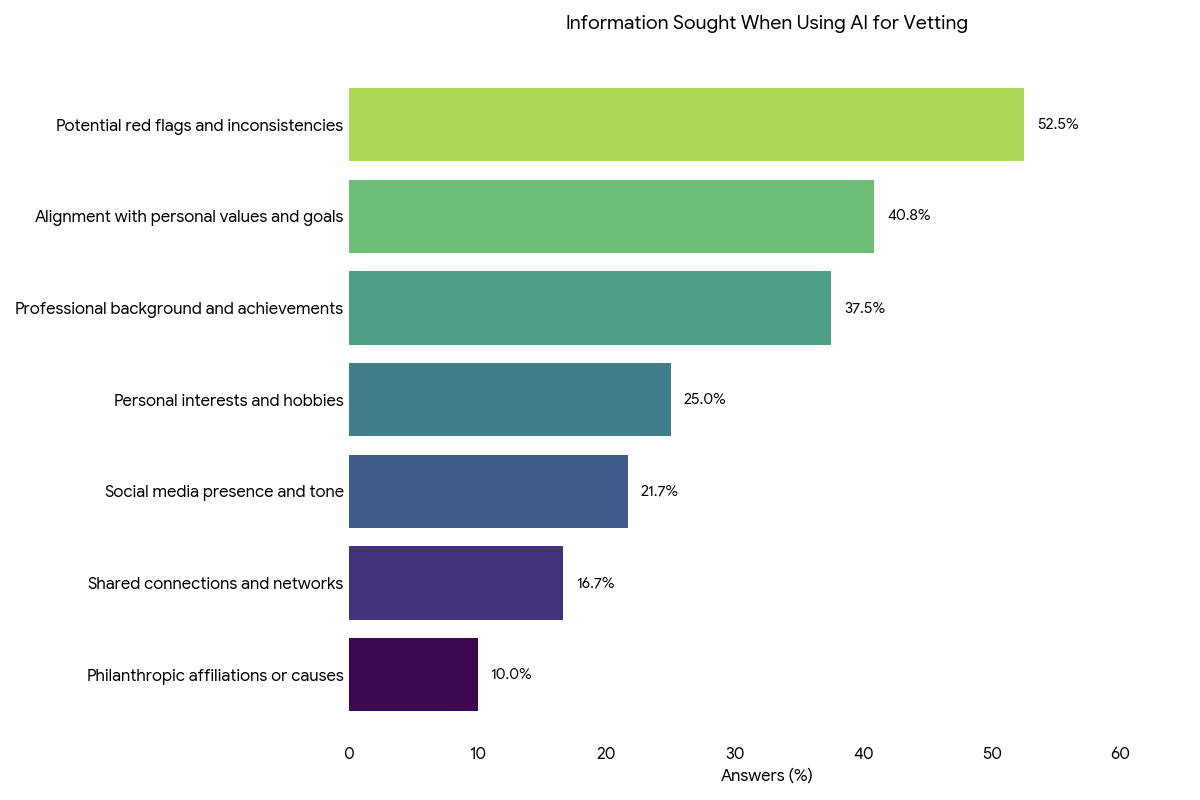
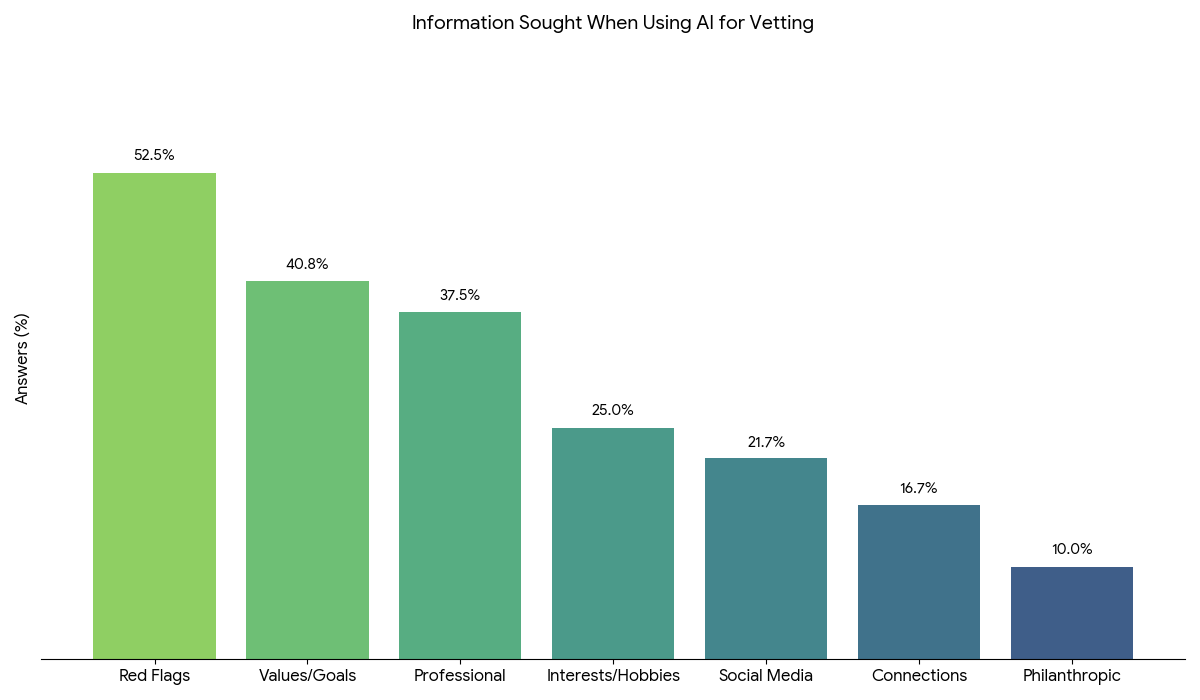
<p class="p3"><strong>1. Identifying Red Flags and Inconsistencies</strong><br>The primary driver for AI vetting is the detection of deception. 52.5% of HNWIs prioritize the identification of "red flags and inconsistencies" above all other data points. In the context of an "Emotional Auditor," this translates to an interest in AI’s ability to flag "Love Bombing" or coercive language patterns. By analyzing the velocity of emotional escalation, the AI can alert the user when a match’s rhetoric deviates from healthy social norms, providing an objective counter-narrative to intense, potentially manipulative affection.</p>
<p class="p3"><strong>2. Financial and Professional Scrutiny</strong><br>The "gold-digger" trope remains a grounded reality for the wealthy. 55% of respondents identified financial risk as their primary concern when meeting new people online, and 37.5% specifically seek AI assistance in vetting a partner's professional background and achievements. An Emotional Auditor serves as a filter for "lifestyle probing"—identifying when a match’s questions focus disproportionately on assets, liquidity, or professional status rather than personal compatibility.</p>
<p class="p3"><strong>3. Reputational Guardrails and Over-Disclosure </strong><br>For individuals whose names are tied to corporations or philanthropic foundations, a lapse in judgment during a private conversation can have public consequences. 35% of HNWIs are concerned about reputational risk, and 29.2% fear the personal impact of embarrassment or social fallout. There is a burgeoning interest in AI that can act as a "reputational coach," flagging when a conversation might be leading toward the over-disclosure of sensitive information that could later be used for blackmail or social engineering.</p>
<p class="p4"> </p>
<h3 class="p5"><strong>The Contextual Divide: Business vs. Romance</strong></h3>
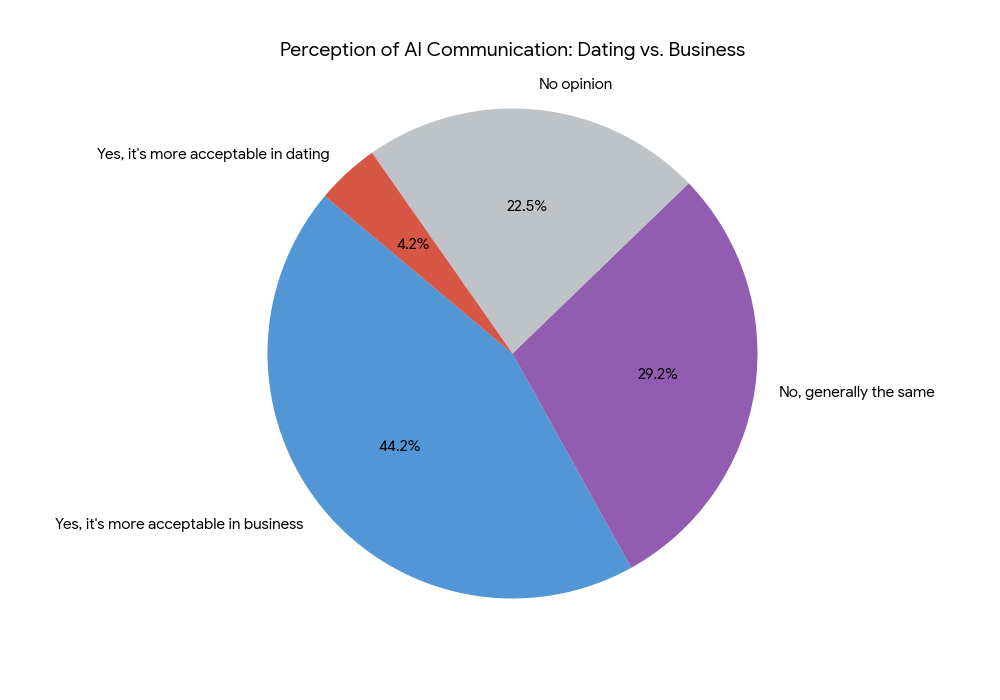
<p class="p3">A notable psychological barrier remains regarding the "romance" of AI. Currently, 44.2% of HNWIs find the use of AI more acceptable in a business context than in dating, while 29.2% believe the perception is the same across both fields. Only a small minority (4.2%) finds it more acceptable in dating.</p>
<figure class="post__image"><img loading="lazy"  src="https://www.onluxy.com/industry-reports-research/media/posts/12/Percentage-of-AI-Communication.png" alt="" width="1000" height="700" sizes="(max-width: 48em) 100vw, 768px" srcset="https://www.onluxy.com/industry-reports-research/media/posts/12/responsive/Percentage-of-AI-Communication-xs.png 300w ,https://www.onluxy.com/industry-reports-research/media/posts/12/responsive/Percentage-of-AI-Communication-sm.png 480w ,https://www.onluxy.com/industry-reports-research/media/posts/12/responsive/Percentage-of-AI-Communication-md.png 768w"></figure>
<p class="p3">This discrepancy highlights a "Sincerity Paradox": HNWIs want the protection of AI, but they fear that using it themselves might make them appear insincere. This is reflected in how they choose to deploy the technology. A dominant 68.3% of HNWIs state they would primarily use their own sentences, using AI only strategically to formulate or refine thoughts. Only 5.8% would directly send AI-generated messages. This suggests that the "Emotional Auditor" should not replace the user’s voice, but rather act as a "co-pilot"—providing a layer of strategic analysis and risk detection while allowing the user to maintain the "human touch" that is essential for genuine connection.</p>
<p class="p4"> </p>
<h3 class="p5"><strong>Real-Time vs. Strategic Analysis </strong></h3>
<p class="p3">The preference for <i>how</i> this information is delivered is shifting toward real-time protection. While HNWIs are cautious about the "authenticity" of AI-generated text, they are highly receptive to AI-generated <i>insights</i>. The data indicates that the elite user views AI as a sophisticated filter. They are less interested in an AI that speaks for them and more interested in an AI that listens for them.</p>
<p class="p3">By focusing on "potential red flags" (a priority for 52.5%) and "alignment with personal values" (40.8%), the Emotional Auditor serves a dual purpose: it is both a shield against the predatory and a compass for the compatible.</p>
<p class="p3">In conclusion, the HNWI community is ready for AI to enter the social sphere, provided it functions as a guardian of their interests rather than a replacement for their personality. The "Emotional Auditor" is perceived as a tool for risk mitigation—addressing the 55% who fear financial loss and the 35% who fear reputational damage—by providing an objective, data-driven layer of scrutiny that human intuition, however refined, cannot achieve alone.</p>
<p class="p2"> </p>
<p class="p2"> </p>
<h2 class="p12"><strong>V. The Practicalities of an AI Emotional Firewall</strong></h2>
<p class="p3">The transition from a theoretical Emotional Firewall to a functional feature online leaves much room for speculation. But in general, such practical application needs to must function as a background auditor, balancing security with a helpful, proactive service typical of a private concierge.</p>
<p class="p6"> </p>
<h3 class="p5"><strong>1. How This AI Auditor Can Look Like</strong></h3>
<p class="p3">The primary architecture of an AI assistant is built upon its analytical capabilities that operate simultaneously to provide a robust defense against manipulation:</p>
<ul class="ul1">
<li class="li9"><strong>Sentiment Tracking:</strong> Real-time analysis of the emotional temperature to identify shifts from genuine interest to high-pressure tactics.</li>
<li class="li9"><strong>Pattern Recognition:</strong> Detection of linguistic fingerprints associated with known bad actors or premature financial inquiries.</li>
<li class="li9"><strong>Anomaly Detection:</strong> Monitoring for deviations from standard HNWI interaction baselines, such as erratic response patterns or attempts to move to unencrypted platforms.</li>
</ul>
<p class="p10"> </p>
<p class="p3">For e.g. users on Luxy, the delivery of information is as critical as the data itself. The system should be presented as a separate feature, accessible for every single match and not generalized:</p>
<ul class="ul1">
<li class="li9"><strong>Nudges:</strong> When texting, adding extra signals when need for caution without interrupting the flow.</li>
<li class="li9"><strong>Actionable Insights:</strong> Providing specific context and more information, such as identifying rapid emotional escalation. Not simply blocking people.</li>
<li class="li9"><strong>Post-Interaction Summaries:</strong> Highlighting underlying dynamics, such as one-sided emotional labor or dominating narratives.</li>
<li class="li9"><strong>Customizable Thresholds:</strong> Allowing people to set their own sensitivity levels for different preferences, ensuring the AI acts as a tailored consultant.</li>
</ul>
<p class="p10"> </p>
<h3 class="p5"><strong>2. Navigating the Authenticity Paradox</strong></h3>
<p class="p3">The implementation of such a tool must be reconciled with the user’s desire for genuine connection, a tension clearly reflected in current community sentiment. When considering the role of AI in personal interactions, there is a distinct boundary that HNWIs are unwilling to cross. Approximately 34% of users view the idea of a perfectly mimicked AI managing their initial interactions as fundamentally inauthentic, while 29% prefer to handle all communications personally from the very first message. This resistance is further highlighted by the fact that only 19% of the community would delegate initial screening to an automated surrogate, and a mere 18% would trust an AI to handle compatibility checks.</p>
<p class="p3">However, a clear distinction exists between automation and assistance. While users largely reject the idea of an AI "mimicking" their personality, there is a massive appetite for strategic guidance. Approximately 73% of respondents indicated they would utilize an AI as a strategic assistant for help and guidance, compared to only 27% who would decline such support. This suggests that for the Emotional Firewall to be successful, it must be positioned as a "wingman" or consultant that clears the path for authenticity by removing predators and noise, rather than a tool that attempts to fabricate the connection itself.</p>
<p class="p4"> </p>
<h3 class="p5"><strong>3. Ethics, Privacy, and the Calibration of Trust </strong></h3>
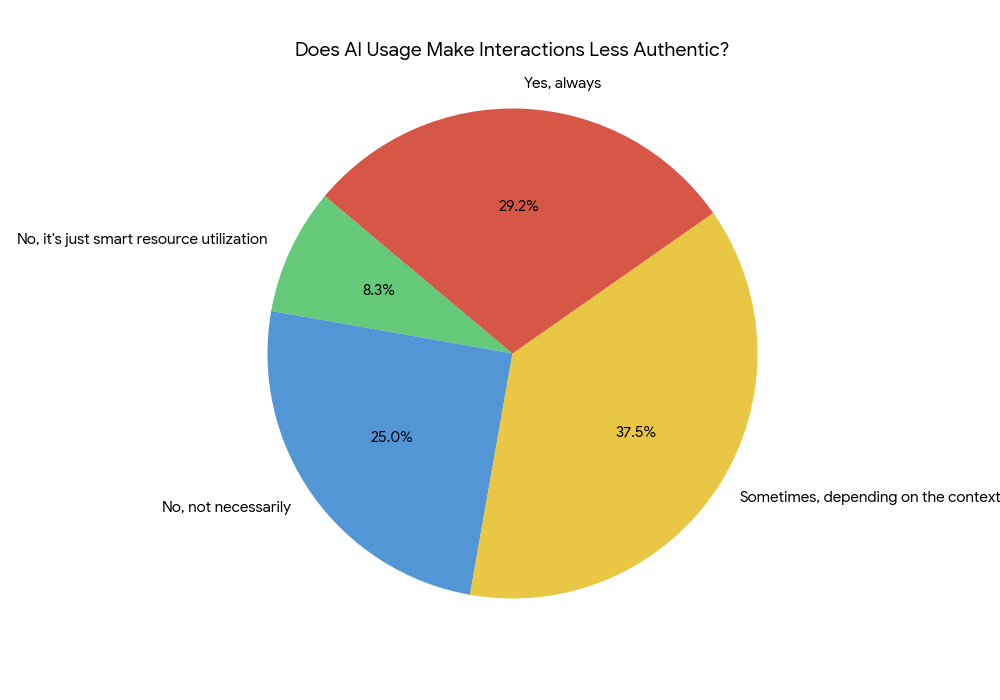
<p class="p3">The final hurdle in deploying an AI Auditor lies in the inherent difficulty of interpreting human complexity and the high value HNWIs place on privacy. The Luxy community remains divided on the morality of AI intervention: while 25% believe that using AI assistance isn't necessarily inauthentic and 8% see it as a smart utilization of available resources, a combined 67% of the community harbors concerns, viewing it as either "sometimes" or "always" less authentic. This high level of skepticism necessitates a transparent approach to data handling, where the AI operates within a localized, encrypted framework that ensures personal data is never used for platform-side mining.</p>
<figure class="post__image"><img loading="lazy"  src="https://www.onluxy.com/industry-reports-research/media/posts/12/AI-Authenticity-2.png" alt="" width="1000" height="700" sizes="(max-width: 48em) 100vw, 768px" srcset="https://www.onluxy.com/industry-reports-research/media/posts/12/responsive/AI-Authenticity-2-xs.png 300w ,https://www.onluxy.com/industry-reports-research/media/posts/12/responsive/AI-Authenticity-2-sm.png 480w ,https://www.onluxy.com/industry-reports-research/media/posts/12/responsive/AI-Authenticity-2-md.png 768w"></figure>
<p class="p3">To bridge this trust gap, the system must account for cultural nuance and individual preference. AI often struggles with sarcasm or high-context communication styles: a direct request for what someone brings to the table might be flagged as a red flag in one culture but viewed as a pragmatic necessity in another. Consequently, this Firewall must allow for personal customization and input. Trust is built when the AI accurately identifies a risk that the user had a gut feeling about but could not quite articulate.</p>
<p class="p2"> </p>
<h2 class="p12"><strong>VI. AI as an Emotional Intelligence Coach </strong></h2>
<p class="p3">The true potential of AI within the Luxy ecosystem lies in its transition from a protective shield to a pedagogical tool. HNWIs, show a clear trend: They do not merely want to be protected but empowered with the emotional intelligence to make better and more informed decisions on their dating journey themselves.</p>
<p class="p6"> </p>
<p class="p3">The survey results indicate a resounding mandate for EQ-focused AI, with approximately 84% of respondents expressing interest in an AI coach. Crucially, a significant portion of the community noted that it is more acceptable for an AI to coach and train the user privately than to interfere directly in communication. This highlights a preference for "social sparring" that sharpens personal instincts while preserving the user’s authenticity and agency.</p>
<p class="p4"> </p>
<h3 class="p5"><strong>1. Core Competencies: Red Flags and Communication</strong></h3>
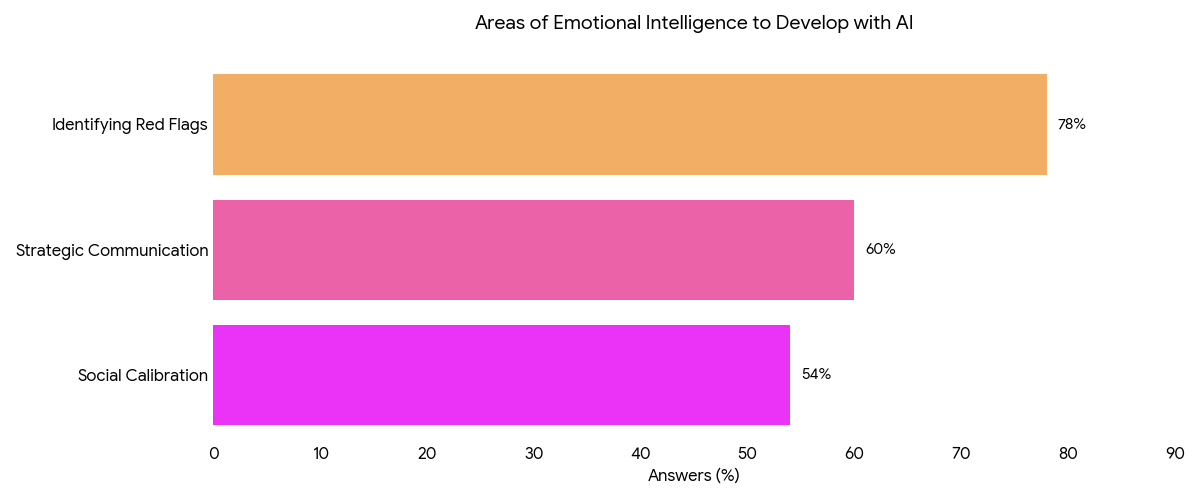
<p class="p3">When identifying specific areas for development, the community prioritized risk assessment and interpersonal strategy:</p>
<figure class="post__image"><img loading="lazy"  src="https://www.onluxy.com/industry-reports-research/media/posts/12/Areas-Emotional-EQ.png" alt="" width="1200" height="500" sizes="(max-width: 48em) 100vw, 768px" srcset="https://www.onluxy.com/industry-reports-research/media/posts/12/responsive/Areas-Emotional-EQ-xs.png 300w ,https://www.onluxy.com/industry-reports-research/media/posts/12/responsive/Areas-Emotional-EQ-sm.png 480w ,https://www.onluxy.com/industry-reports-research/media/posts/12/responsive/Areas-Emotional-EQ-md.png 768w"></figure>
<ul class="ul1">
<li class="li9"><strong>Identifying Red Flags (78%):</strong> The primary demand is for an AI that explains the "why" behind concerning patterns, teaching users to spot inconsistencies independently.</li>
<li class="li9"><strong>Strategic Communication (60%):</strong> Users seek feedback on their own tone, clarity, and empathy to ensure their digital presence aligns with their intentions.</li>
<li class="li9"><strong>Social Calibration (54%):</strong> Over half of respondents want guidance on "social radar"—knowing when to pursue a topic, when to retreat, and how to better understand the emotional states or motivations of others. This includes practical advice on setting boundaries effectively without stifling connection.</li>
</ul>
<p class="p10"> </p>
<h3 class="p5"><strong>2. Vetting for Value Alignment</strong></h3>
<p class="p3">The data regarding vetting preferences reinforces that HNWIs are looking beyond superficial metrics. While identifying potential red flags remains the priority (52.5%), the focus has shifted toward deeper compatibility:</p>
<figure class="post__image"><img loading="lazy"  src="https://www.onluxy.com/industry-reports-research/media/posts/12/AI-Vetting-Categories.png" alt="" width="1200" height="700" sizes="(max-width: 48em) 100vw, 768px" srcset="https://www.onluxy.com/industry-reports-research/media/posts/12/responsive/AI-Vetting-Categories-xs.png 300w ,https://www.onluxy.com/industry-reports-research/media/posts/12/responsive/AI-Vetting-Categories-sm.png 480w ,https://www.onluxy.com/industry-reports-research/media/posts/12/responsive/AI-Vetting-Categories-md.png 768w"></figure>
<ul class="ul1">
<li class="li9"><strong>Alignment with Personal Values (40.8%):</strong> This ranked higher than traditional status markers.</li>
<li class="li9"><strong>Professional Background (37.5%) and Personal Interests (25%):</strong> These remain baseline requirements for the demographic.</li>
<li class="li9"><strong>Social Media Tone and Presence (21.7%):</strong> Users are increasingly interested in how a prospect’s digital footprint reflects their character.</li>
<li class="li9">Shared networks (16.7%) and philanthropic affiliations (10%) were seen as less critical than behavioral consistency.</li>
</ul>
<p class="p10"> </p>
<h3 class="p5"><strong>3. The AI as a Strategic Asset</strong></h3>
<p class="p3">By focusing on coaching rather than just filtering, the AI becomes a long-term asset. It transforms the dating experience from a series of risks into a journey of personal growth. Instead of creating a dependency, the system acts as emotional scaffolding—helping users communicate boundaries and interpret motivations, eventually leading to more successful, authentic, and self-managed relationships.</p>
<p class="p2"> </p>
<p class="p2"> </p>
<h2 class="p12"><strong>VII. Implications for Luxy &amp; the Future of Online Dating</strong></h2>
<p class="p4"> </p>
<p class="p3">The integration of AI systems within the Luxy ecosystem would mark a paradigm shift from traditional online dating to an Intelligent Relationship Management. The focus should remain on the delicate balance between technological efficiency and the human touch that defines the elite experience.</p>
<p class="p4"> </p>
<h3 class="p5"><strong>1. Ethical Considerations &amp; Trust Building</strong></h3>
<p class="p3">For HNWIs, trust is one of the most important considerations. The implementation of AI must be governed by a framework of radical transparency and user agency.</p>
<ul class="ul1">
<li class="li9"><strong>Transparency and Disclosure:</strong> Luxy must maintain an "Open Box" policy regarding its algorithms. Users should be clearly informed when they are interacting with an AI coach or when an automated system has flagged a potential risk. Providing the "reasoning" behind AI suggestions—such as citing specific behavioral patterns—prevents the technology from feeling like a "black box" and builds cognitive trust.</li>
<li class="li9"><strong>User Sovereignty and Control:</strong> AI features should be modular and opt-in. Whether it is the "EQ Coach" or the "Automated Vetting" suite, users must retain the power to toggle these features based on their comfort level. Furthermore, data privacy must exceed industry standards, ensuring that the analysis of communication patterns is used solely for the user’s benefit and never monetized or shared.</li>
<li class="li9"><strong>The Human-in-the-Loop (HITL) Model:</strong> AI is a supplement, not a replacement, for human judgment. Luxy should maintain a tier of human moderators and relationship experts who oversee high-level disputes or complex vetting scenarios. This ensures that the "Elite" status of the platform is maintained by human standards of excellence, supported by machine precision.</li>
</ul>
<p class="p10"> </p>
<h3 class="p5"><strong>2. Strategic Outlook: Emerging Horizons </strong></h3>
<p class="p3">The future of elite dating will likely see the expansion of AI into even more immersive and protective territories:</p>
<ul class="ul1">
<li class="li9"><strong>Biometric Verification &amp; Deepfake Defense:</strong> As synthetic media becomes more sophisticated, Luxy will lead in implementing cryptographic identity verification to ensure that every profile is 100% authentic.</li>
<li class="li9"><strong>Virtual "Safe-Space" Simulations:</strong> Using AI to create low-stakes virtual environments where users can practice social interactions or "meet" in a secure, simulated high-end venue before transitioning to physical reality.</li>
<li class="li9"><strong>Long-term Compatibility Analytics:</strong> Shifting the focus from "the first date" to "long-term alignment" by analyzing shared values and life goals through deeper, AI-assisted discovery phases.</li>
</ul>
<p class="p6"> </p>
<p class="p6"> </p>
<p class="p3">By adopting these technologies, Luxy can position itself not just as a dating app, but as a pioneer in <strong>Intelligent Social Safety</strong>. While competitors focus on volume and gamification, Luxy’s trajectory is toward a real but selective dating approach.</p>
<ul class="ul1">
<li class="li9"><strong>Predictive Safety:</strong> Moving from reactive blocking to proactive prevention using sentiment analysis and behavioral forecasting.</li>
<li class="li9"><strong>Global Standards for Elite Digital Conduct:</strong> Luxy has the opportunity to set the standard for how high-status individuals interact online, creating a digital environment where the barrier to entry is not just wealth, but character and emotional intelligence.</li>
</ul>
<p class="p6"> </p>
<p class="p3">The evolution of Luxy represents a commitment to the idea that technology should make us more human, not less. By leveraging AI to filter out the noise of deception and the friction of social anxiety, we are clearing the path for what truly matters: authentic, high-value human connection.</p>
<p class="p3">The future of elite dating is one where security is invisible but absolute, and where intelligence serves as the foundation for lasting relationships. Luxy is elevating the standard of how they connect, ensuring that every interaction is as secure as it is significant.</p>
            ]]>
        </content>
    </entry>
    <entry>
        <title>Decoding the Millionaire Life: Unveiling the Habits and Hangouts of HNWIs</title>
        <author>
            <name>Dr. Max Langdon</name>
        </author>
        <link href="https://www.onluxy.com/industry-reports-research/millionaire-life.html"/>
        <id>https://www.onluxy.com/industry-reports-research/millionaire-life.html</id>
        <media:content url="https://www.onluxy.com/industry-reports-research/media/posts/11/shutterstock_736954291.jpg" medium="image" />

        <updated>2026-01-12T17:09:00+08:00</updated>
            <summary type="html">
                <![CDATA[
                        <img src="https://www.onluxy.com/industry-reports-research/media/posts/11/shutterstock_736954291.jpg" alt="" />
                    1. Introduction and Summary The 2026 report on decoding High-Net-Worth Individuals (HNWIs) lifestyles pulls back the velvet curtain on the&hellip;
                ]]>
            </summary>
        <content type="html">
            <![CDATA[
                    <p><img src="https://www.onluxy.com/industry-reports-research/media/posts/11/shutterstock_736954291.jpg" class="type:primaryImage" alt="" /></p>
                <h2 class="p1"><strong>1. Introduction and Summary </strong></h2>
<p class="p2">The 2026 report on decoding High-Net-Worth Individuals (HNWIs) lifestyles pulls back the velvet curtain on the world’s most successful singles. Moving beyond the stereotypes of isolated island-dwellers, this report reveals a demographic that is deeply connected, intellectually driven, and surprisingly grounded. Based on a comprehensive analysis and survey of over 1000 members across North America and Western Europe, our findings show that today’s HNWIs prioritize growth over glamour. While they command significant capital, their leisure time is dedicated to local community impact, lifelong learning, and the pursuit of "quiet luxury" through travel and culinary arts. This executive summary serves as a roadmap to understanding where the world's wealth resides and how it chooses to spend its most precious commodity: time.</p>
<p class="p2">In an era of digital saturation, Luxy stands as a beacon for the "Top 1%." Established as the main destination for successful, attractive, and ambitious individuals, Luxy is more than a dating app, an exclusive community for those looking for a partner that truly matches. By analyzing the geographical hotspots and lifestyle habits of our members, we provide a definitive look at the current state of high-end dating and the values that define the modern HNWI.</p>
<h3 class="p3"><strong>Key Findings at a Glance</strong></h3>
<table class="t1" cellspacing="0" cellpadding="0">
<tbody>
<tr>
<td class="td1" valign="middle">
<p class="p4"><strong>Category</strong></p>
</td>
<td class="td2" valign="middle">
<p class="p4"><strong>Key Insight</strong></p>
</td>
</tr>
<tr>
<td class="td3" valign="middle">
<p class="p4"><strong>Top Locations (USA)</strong></p>
</td>
<td class="td4" valign="middle">
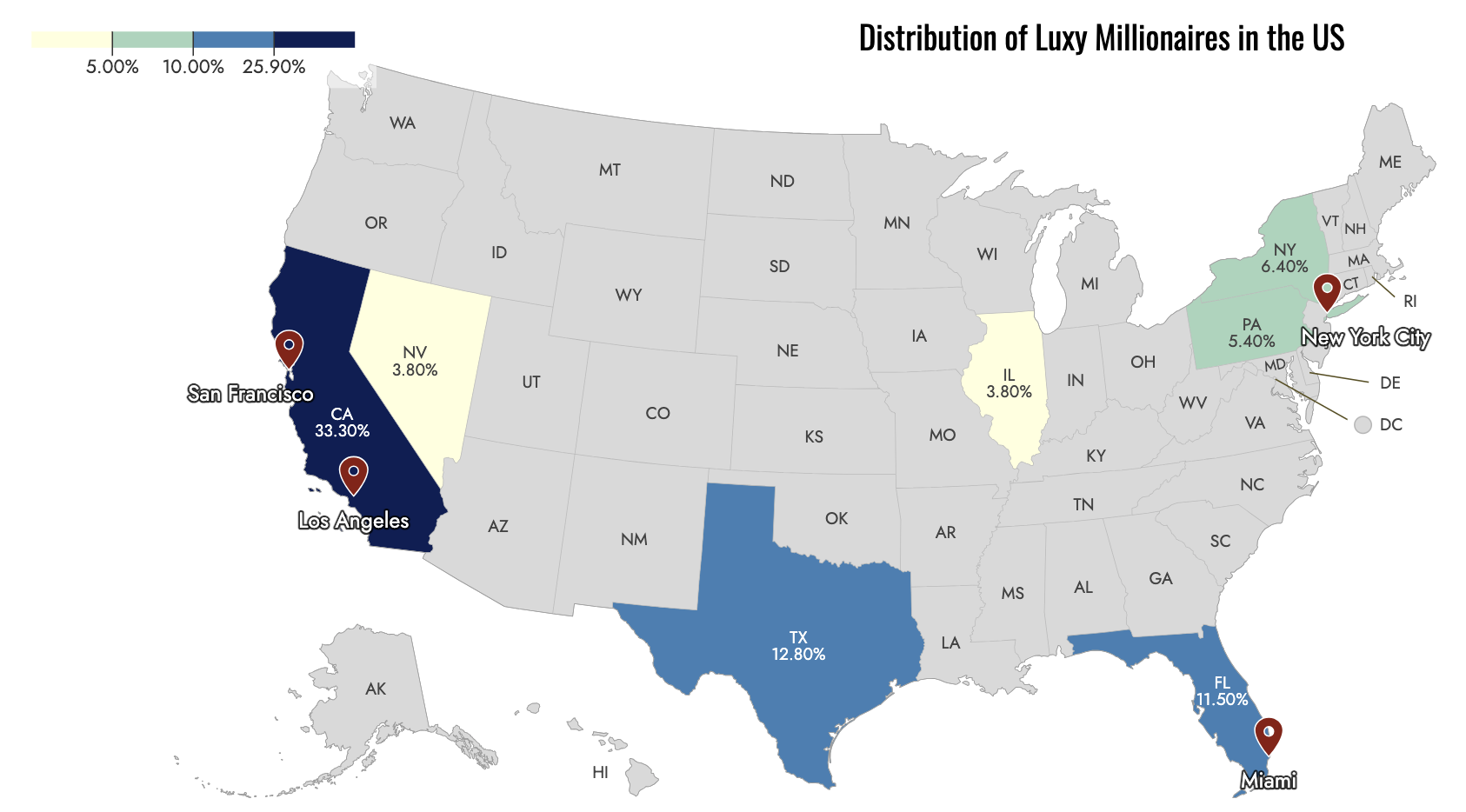
<p class="p4"><strong>California (33.3%)</strong> leads, followed by Texas and Florida. But surprisingly Nevada also makes the top 6.</p>
</td>
</tr>
<tr>
<td class="td5" valign="middle">
<p class="p4"><strong>Top Locations (Europe)</strong></p>
</td>
<td class="td6" valign="middle">
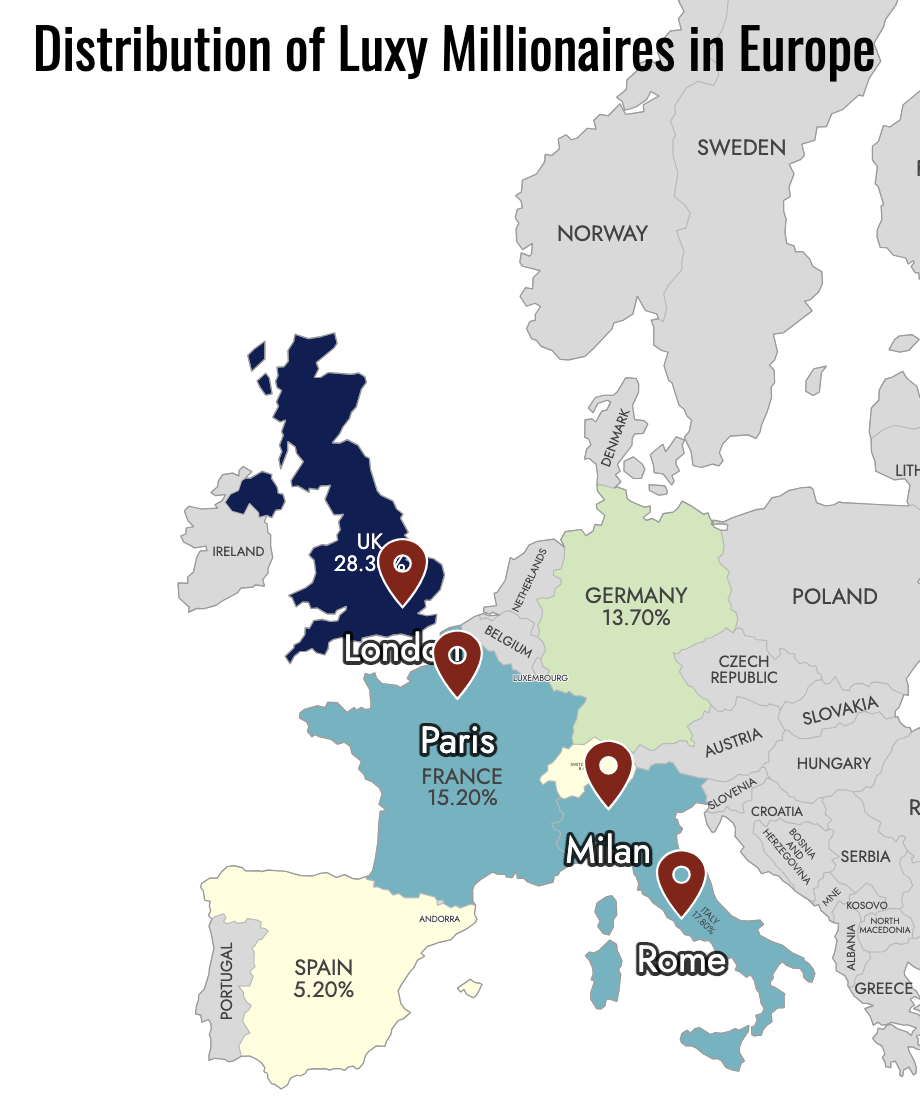
<p class="p4"><strong>The United Kingdom (28.3%)</strong> remains the crown jewel, anchored by London. Italy and France follow.</p>
</td>
</tr>
<tr>
<td class="td7" valign="middle">
<p class="p4"><strong>Average Age</strong></p>
</td>
<td class="td8" valign="middle">
<p class="p4">Members typically fall within the <strong>34–42 age bracket</strong>, representing "Peak Career" success.</p>
</td>
</tr>
<tr>
<td class="td9" valign="middle">
<p class="p4"><strong>Primary Passion</strong></p>
</td>
<td class="td10" valign="middle">
<p class="p4"><strong>Travel (43%)</strong>, with a heavy lean toward international frequent-flyer status.</p>
</td>
</tr>
<tr>
<td class="td7" valign="middle">
<p class="p4"><strong>Philanthropy</strong></p>
</td>
<td class="td8" valign="middle">
<p class="p4">An overwhelming <strong>82%</strong> of members are active in charitable giving.</p>
</td>
</tr>
</tbody>
</table>
<p class="p5"> </p>
<p class="p6"> </p>
<p class="p6"> </p>
<h2 class="p3"><strong>2.1 The Humble Luxy Millionaire</strong></h2>
<p class="p2">While the data confirms certain luxury trends, several findings challenged our initial assumptions:</p>
<ul class="ul1">
<li class="li2">Contrary to the "rocket science and private islands" trope, the most popular hobbies are strikingly relatable. <strong>Gardening and landscaping</strong> (11%) and <strong>self-improvement</strong> (23%) outrank more "cliché" hobbies like yachting or shooting.</li>
<li class="li2"><strong>The Charity Paradox:</strong> Wealthy individuals aren't just writing checks to global NGOs, they are <strong>hyper-local.</strong> A significant majority focuses on local poverty relief, youth sports coaching, and community education, showing a desire for tangible, visible impact.</li>
<li class="li2"><strong>The Travel Shift:</strong> While they have the means for constant adventure, <strong>83% of HNWIs</strong> prioritize "relaxation" above all else when vacationing. In a world of high-pressure decisions, the ultimate luxury is the ability to simply unplug.</li>
<li class="li2"><strong>The "Dolce Vita" Revival:</strong> Italy has surged as a major wealth magnet in Europe (17.8%), suggesting that HNWIs are increasingly trading the industrial grind for a life centered on culture, art, and the "sweet life."</li>
</ul>
<p class="p7"> </p>
<p class="p2">Ultimately, this report serves as a briefing to the fact that modern success is no longer defined by a static destination, but by a dynamic and purposeful way of living. By peeling back the layers of this high-performing community, we move beyond the balance sheet to uncover the human stories, habits, and geographies that define the 21st-century elite.</p>
<h2 class="p2"><span class="s2"><strong>2. Where the Wealth Resides </strong></span></h2>
<p class="p2">This chapter delves into the geographical distribution of millionaires and HNWIs utilizing the Luxy dating app. The insights presented are derived from a comprehensive survey conducted among over 10,000 Luxy users located across North America and Western Europe. Approximately 70% of the responses originated from individuals residing within the United States, while the remaining 30% were contributed by users based in Western European countries. We will take a look at them separately.</p>
<p class="p6"> </p>
<h3 class="p3"><strong>2.1 Geographical Hotspots in the USA</strong></h3>
<p class="p2">While wealth is distributed across the nation, certain states and metropolitan areas emerge as clear magnets for affluent individuals.</p>
<figure class="post__image"><img loading="lazy"  src="https://www.onluxy.com/industry-reports-research/media/posts/11/millionaires-usa.png" alt="" width="1686" height="934" sizes="(max-width: 48em) 100vw, 768px" srcset="https://www.onluxy.com/industry-reports-research/media/posts/11/responsive/millionaires-usa-xs.png 300w ,https://www.onluxy.com/industry-reports-research/media/posts/11/responsive/millionaires-usa-sm.png 480w ,https://www.onluxy.com/industry-reports-research/media/posts/11/responsive/millionaires-usa-md.png 768w"></figure>
<h4 class="p2"><strong>The Golden State Shines: California's Dominance (33.3%)</strong></h4>
<p class="p2">California comes first, attracting 33.3% of Luxy’s US-based HNWI respondents. This dominance is hardly surprising, given California's status as a global hub for technology, entertainment, and innovation. The state's diverse economy, coupled with its desirable climate and lifestyle, makes it an irresistible draw for those seeking both financial success and personal fulfillment.</p>
<p class="p2"><strong>Los Angeles and San Francisco Lead the Charge:</strong> <br>Within California, Los Angeles and San Francisco are the most frequently mentioned cities. Los Angeles, with its thriving entertainment industry and luxury real estate market, attracts entrepreneurs, executives, and creatives alike. San Francisco, the heart of Silicon Valley, is a magnet for tech titans and venture capitalists.</p>
<p class="p6"> </p>
<h4 class="p2"><strong>Texas: Big Wealth in the Lone Star State (12.8%)</strong></h4>
<p class="p2">Texas, with 12.8% of our US-based HNWI respondents, secures the second spot. The state's business-friendly environment, lack of state income tax, and booming energy sector make it an attractive destination for wealth creation and preservation.</p>
<p class="p2"><strong>Dallas: A Rising Star:</strong> <br>Dallas stands out as a prominent metropolitan area within Texas. The city's strong economy, affordable cost of living (compared to coastal cities), and growing cultural scene are attracting a new wave of affluent residents.</p>
<p class="p6"> </p>
<h4 class="p2"><strong>Sunshine and Savings: Florida's Tax Haven Appeal (11.5%)</strong></h4>
<p class="p2">Florida, with 11.5% of our US-based HNWI respondents, benefits from its warm climate, beautiful beaches, and favorable tax policies. The absence of state income tax, coupled with a relatively low cost of living, makes Florida a popular choice for retirees and those seeking to maximize their wealth.</p>
<p class="p2"><strong>Miami: A Global Playground:</strong> <br>Miami, with its vibrant nightlife, luxury real estate, and international flair, is a major draw for HNWIs. The city's growing financial sector and its proximity to Latin America make it a strategic location for global business.</p>
<p class="p6"> </p>
<h4 class="p2"><strong>The East Coast Contenders: New York and Pennsylvania (6.4% and 5.4% respectively)</strong></h4>
<p class="p2">New York (6.4%) and Pennsylvania (5.4%), while not as dominant as California, Texas, or Florida, still represent significant concentrations of wealth. New York City, as a global financial center, continues to attract high-earning professionals in finance, law, and media. Pennsylvania, with its rich history, diverse economy, and proximity to major East Coast cities, offers a more understated appeal.</p>
<p class="p6"> </p>
<p class="p6"> </p>
<h4 class="p2"><strong>The Curious Case of Nevada and Illinois (3.8% Each)</strong></h4>
<p class="p2">Nevada and Illinois, both accounting for 3.8% of our US-based HNWI respondents, present an interesting contrast. Nevada, with its low taxes and entertainment industry, attracts a specific type of affluent individual seeking a more unconventional lifestyle. Illinois, anchored by the city of Chicago, offers a more traditional urban environment with a strong business community and cultural institutions.</p>
<p class="p2"><strong>Potential Explanations for the Tie:</strong></p>
<ul class="ul1">
<li style="list-style-type: none;">
<ul class="ul2">
<li class="li9"><strong>Different Appeals:</strong> Nevada attracts those seeking tax advantages and a vibrant entertainment scene, while Illinois appeals to those seeking a strong business environment and cultural amenities.</li>
<li class="li9"><strong>Chicago's Influence:</strong> Chicago, as a major financial hub and cultural center, likely accounts for the majority of HNWIs in Illinois.</li>
<li class="li9"><strong>Data Nuances:</strong> The relatively small sample size within these states could lead to statistical fluctuations, resulting in the same percentage despite potentially different underlying factors.</li>
</ul>
</li>
</ul>
<p class="p6"> </p>
<p class="p8"> </p>
<p class="p2">The geographical distribution of HNWIs within the United States reflects a complex interplay of economic opportunities, lifestyle preferences, and tax considerations. California, Texas, and Florida emerge as the dominant states, each offering a unique blend of attractions for affluent individuals. While New York and Pennsylvania maintain their presence, the equal representation of Nevada and Illinois highlights the diverse factors that influence residential choices among the wealthy. As we delve deeper into the demographics and habits of these individuals, we will gain a more nuanced understanding of the Luxy lifestyle.</p>
<p class="p10"> </p>
<h3 class="p3"><strong>2.2. Where the Wealth Resides: Geographical Hotspots in Western Europe</strong></h3>
<p class="p11"><strong> </strong></p>
<h4 class="p2"><strong>A European Perspective: Unveiling Wealth Across the Atlantic</strong></h4>
<p class="p2">While the United States dominates our survey responses, a significant 30% of our HNWI respondents reside in Western Europe. This provides valuable insight into the distribution of wealth and lifestyle preferences across the Atlantic. While certain major cities emerge as hubs, the European landscape reveals a more nuanced pattern of affluence, with smaller towns and regions also attracting a considerable share of wealthy individuals.</p>
<figure class="post__image"><img loading="lazy"  src="https://www.onluxy.com/industry-reports-research/media/posts/11/millionaires-eu.png" alt="" width="920" height="1108" sizes="(max-width: 48em) 100vw, 768px" srcset="https://www.onluxy.com/industry-reports-research/media/posts/11/responsive/millionaires-eu-xs.png 300w ,https://www.onluxy.com/industry-reports-research/media/posts/11/responsive/millionaires-eu-sm.png 480w ,https://www.onluxy.com/industry-reports-research/media/posts/11/responsive/millionaires-eu-md.png 768w"></figure>
<p class="p8"> </p>
<h4 class="p2"><strong>The United Kingdom: London's Magnetic Pull (28.3%)</strong></h4>
<p class="p2">The United Kingdom leads the way in Western Europe, attracting 28.3% of our European-based HNWI respondents. This dominance is largely attributed to London's status as a global financial center, a cultural powerhouse, and a hub for international business.</p>
<ul class="ul1">
<li class="li9"><strong>London: A Global Metropolis:</strong> London stands out as the most frequently mentioned city in Western Europe. Its concentration of financial institutions, luxury real estate, and high-end amenities makes it an irresistible draw for affluent individuals from around the world.</li>
</ul>
<p class="p6"> </p>
<h4 class="p2"><strong>Italy: HNWIs Attraction of the Dolce Vita (17.8%)</strong></h4>
<p class="p2">Italy, with 17.8% of our European-based HNWI respondents, offers a unique combination of historical charm, cultural richness, and luxurious living. The country's diverse regions, from the fashion capital of Milan to the art-filled streets of Florence, cater to a wide range of tastes and preferences.</p>
<ul class="ul1">
<li class="li9"><strong>Rome and Milan: Centers of Attraction:</strong> Rome and Milan are the most prominent cities in Italy for HNWIs. Rome, with its ancient ruins and vibrant cultural scene, appeals to those seeking a blend of history and modernity. Milan, as a global fashion and design hub, attracts entrepreneurs and creatives in the luxury sector.</li>
</ul>
<p class="p6"> </p>
<h4 class="p2"><strong>France: Elegance and Sophistication (15.2%)</strong></h4>
<p class="p2">France, with 15.2% of our European-based HNWI respondents, embodies elegance, sophistication, and a rich cultural heritage. The country's renowned cuisine, world-class art museums, and picturesque countryside make it a popular destination for affluent individuals seeking a refined lifestyle.</p>
<ul class="ul1">
<li class="li9"><strong>Paris: The City of Lights:</strong> Paris, with its iconic landmarks, haute couture boutiques, and Michelin-starred restaurants, is a major draw for HNWIs. The city's reputation as a global center for art, fashion, and culture continues to attract affluent residents from around the world.</li>
</ul>
<p class="p6"> </p>
<h4 class="p2"><strong>Germany, Switzerland, and Spain: A Different Distribution (13.7%, 8.6%, and 5.2% respectively)</strong></h4>
<p class="p2">Germany (13.7%), Switzerland (8.6%), and Spain (5.2%) present a contrasting picture compared to the UK, Italy, and France. In these countries, HNWIs on Luxy are less concentrated in major metropolitan areas and more dispersed across smaller towns and regions.</p>
<ul class="ul1">
<li class="li9"><strong>Germany:</strong> While cities like Munich and Frankfurt hold economic significance, Germany's wealth is distributed across a network of smaller industrial and commercial centers. This reflects the country's decentralized economic structure and its emphasis on manufacturing and engineering.</li>
<li class="li9"><strong>Switzerland:</strong> Switzerland's appeal lies in its political stability, low taxes, and high quality of life. HNWIs are drawn to the country's picturesque towns and villages, particularly in the Swiss Alps and around Lake Geneva, where they can enjoy privacy, security, and access to outdoor activities.</li>
<li class="li9"><strong>Spain:</strong> While cities like Madrid and Barcelona attract some affluent residents, Spain's wealth is also distributed along its coastal regions and in smaller towns with rich cultural heritage. The country's warm climate, beautiful beaches, and relaxed lifestyle make it an attractive destination for those seeking a more laid-back existence.</li>
</ul>
<h4 class="p2"><strong><br>Potential Reasons for the Distribution:</strong></h4>
<ul class="ul1">
<li class="li9"><strong>Historical and Economic Factors:</strong> The distribution of wealth in Western Europe is influenced by historical patterns of trade, industrial development, and political structures. Countries like the UK and France, with their colonial past and centralized governments, have historically concentrated wealth in their capital cities.</li>
<li class="li9"><strong>Tax Policies and Regulations:</strong> Tax policies and regulations play a significant role in attracting or deterring HNWIs. Countries like Switzerland, with their low taxes and strict banking secrecy laws, have traditionally been havens for wealth.</li>
<li class="li9"><strong>Lifestyle Preferences:</strong> Lifestyle preferences also influence residential choices. Some HNWIs prefer the hustle and bustle of major cities, while others seek the tranquility and privacy of smaller towns and rural areas.</li>
<li class="li9"><strong>Cultural and Social Factors:</strong> Cultural and social factors, such as language, cuisine, and social norms, can also play a role in attracting or deterring HNWIs.</li>
</ul>
<p class="p6"> </p>
<p class="p6"><strong> </strong></p>
<p class="p2">The geographical distribution of HNWIs in Western Europe reflects a complex interplay of historical, economic, political, and cultural factors. While major cities like London, Paris, Rome, and Milan continue to attract a significant share of affluent individuals, the European landscape also reveals a more nuanced pattern of affluence, with smaller towns and regions offering unique attractions for those seeking a refined and fulfilling lifestyle. This diverse distribution underscores the importance of understanding the specific factors that drive residential choices among the wealthy in different European countries.</p>
<p class="p10"> </p>
<p class="p9"> </p>
<h2 class="p1"><strong>3. Leisure &amp; Lifestyle: How the Wealthy Unwind</strong></h2>
<p class="p8"> </p>
<p class="p2">Wealth, beyond its material manifestations, unlocks access to a world of experiences and opportunities for personal enrichment. For High-Net-Worth Individuals (HNWIs), leisure time becomes a canvas for pursuing passions, cultivating interests, and engaging in activities that provide both relaxation and intellectual stimulation. In this chapter, we delve into the leisure pursuits of Luxy members, exploring the diverse range of hobbies and activities that define their lifestyles.<br><br>Wealth, beyond its material manifestations, unlocks access to a world of experiences and opportunities for personal enrichment. But does affluence necessarily translate into exotic or extravagant hobbies? Do millionaires pursue super-exclusive passions, or are their interests more down-to-earth? Surprisingly, for millionaires on Luxy, leisure time often means time for modest passions, cultivating interests, and engaging in activities that provide both relaxation and intellectual stimulation. Below we take a closer Look at the Luxy member’s hobbies and activities that define their lifestyles.</p>
<h3 class="p3"><strong>3.1. Top 10 Hobbies Among Luxy's Millionaire Members</strong></h3>
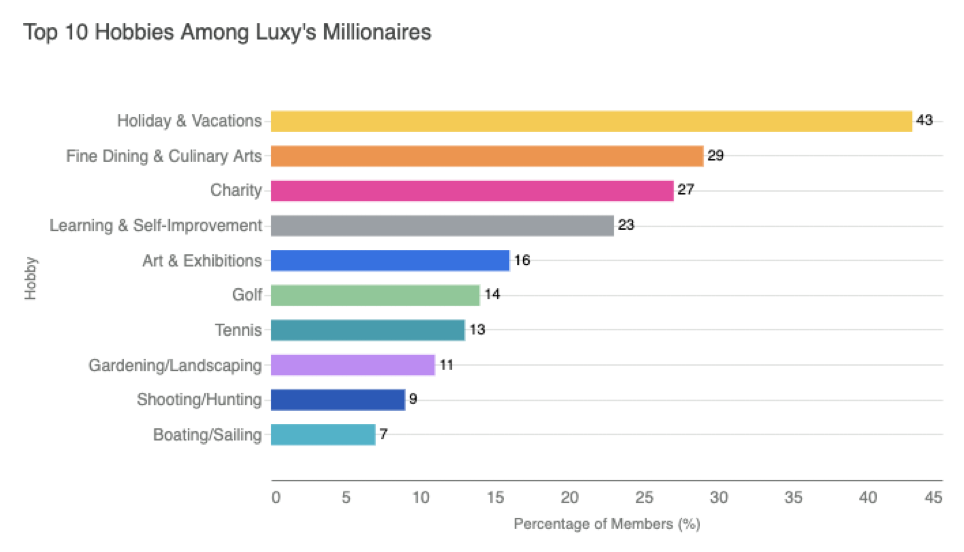
<p class="p2">Our survey reveals a fascinating array of hobbies that capture the attention of Luxy's HNWI members. The data, allowing for multiple selections, provides a comprehensive view of their diverse interests.</p>
<figure class="post__image"><img loading="lazy"  src="https://www.onluxy.com/industry-reports-research/media/posts/11/hobbies-millionaires-2.png" alt="" width="964" height="552" sizes="(max-width: 48em) 100vw, 768px" srcset="https://www.onluxy.com/industry-reports-research/media/posts/11/responsive/hobbies-millionaires-2-xs.png 300w ,https://www.onluxy.com/industry-reports-research/media/posts/11/responsive/hobbies-millionaires-2-sm.png 480w ,https://www.onluxy.com/industry-reports-research/media/posts/11/responsive/hobbies-millionaires-2-md.png 768w"></figure>
<ol class="ol1">
<li class="li2"><strong>Holiday &amp; Vacations (43%): Exploration and Escape</strong><br>Unsurprisingly, travel tops the list, with 43% of respondents citing "Holiday &amp; Vacations" as a primary passion. For HNWIs, travel means more than regular package vacation, sun and free time: it's an opportunity for exploration, cultural immersion, and personal rejuvenation. From exotic destinations to secluded retreats, the world becomes their playground, offering a chance to escape the demands of their professional lives and create lasting memories.</li>
<li class="li2"><strong>Fine Dining &amp; Culinary Arts (29%): A Taste for the Exquisite</strong><br>Dining and culinary arts attract 29% of respondents, with a notable priority towards women. This suggests a deep appreciation for new gastronomic experiences, from savoring Michelin-starred cuisine to experimenting with new recipes of different cuisines at home. For these individuals, food is not merely sustenance but an art form, a source of pleasure, and a way to connect with different cultures.</li>
<li class="li2"><strong>Charity (27%): Giving Back and Making a Difference</strong><br>A significant 27% of respondents engage in charitable activities, highlighting a commitment to social responsibility and a desire to make a positive impact on the world. For HNWIs, philanthropy is not just writing checks but regularly participating in causes they care about, leveraging their resources and influence to address pressing social issues in their communities.</li>
<li class="li2"><strong>Learning &amp; Self-Improvement (23%): A Quest for Knowledge and Growth</strong><br>The pursuit of knowledge and personal growth is a key motivator for 23% of respondents. This category encompasses a wide range of activities, from attending online courses and workshops to learning new languages and skills. Intellectual stimulation is a lifelong pursuit for millionaires, a way to stay engaged, expand their horizons, and remain competitive in a rapidly changing world.</li>
<li class="li2"><strong>Art &amp; Exhibitions (16%): Appreciating Beauty and Creativity</strong><br>Art and exhibitions appeal to 16% of respondents, with a higher proportion of women. This suggests a deep appreciation for aesthetics, creativity, and cultural expression. From visiting world-renowned museums to collecting contemporary art, these individuals immerse themselves in the world of art, finding inspiration and enrichment in the works of others.</li>
<li class="li2"><strong>Golf (14%): The Strategic Game of Leisure</strong><br>Golf, with 14% of respondents, is a popular pastime, particularly among men. Beyond the physical exercise and outdoor enjoyment, golf offers a unique blend of strategy, skill, and social interaction. For HNWIs, the golf course serves as a place to relax, network, and engage in friendly competition.</li>
<li class="li2"><strong>Tennis (13%): The Thrill of the Court</strong><br>Tennis, with 13% of respondents, is another popular sport, also favored by men. The fast-paced nature of the game, the physical challenge, and the opportunity for social interaction make it an appealing activity for those seeking both exercise and entertainment.</li>
<li class="li2"><strong>Gardening/Landscaping (11%): Cultivating Beauty and Serenity</strong><br>Gardening and landscaping attract 11% of respondents, with a significant male presence. This hobby extends beyond simply tending to plants; it encompasses activities such as caring for their land and engaging in physical activities like chopping wood. For HNWIs, gardening and landscaping offer a connection to nature, a sense of accomplishment, and a way to create a beautiful and serene environment around their homes.</li>
<li class="li2"><strong>Shooting/Hunting (9%): The Pursuit of Skill and Tradition</strong><br>Shooting and hunting, with 9% of respondents, are predominantly male activities. These pursuits offer a unique blend of skill, tradition, and connection to nature. For HNWIs, shooting and hunting may represent a way to challenge themselves, hone their skills, and connect with a long-standing heritage.</li>
<li class="li2"><strong>Boating/Sailing (7%): Embracing the Open Water</strong><br>Boating and sailing, with 7% of respondents, are also primarily male-dominated hobbies. These activities offer a sense of freedom, adventure, and connection to the marine environment. For HNWIs, owning and operating a boat or yacht represents a symbol of success and a gateway to exploring the world's oceans and waterways.</li>
</ol>
<p class="p8"> </p>
<p class="p2">It turns out the hobbies of most millionaires on Luxy are not about private islands and rocket science. Their passions are surprisingly relatable, yet different from the every day guy. Sure, they are not limited to anything, but their downtime often revolves around things many of us enjoy: traveling to see the world, giving back to causes they care about, and working on becoming better versions of themselves. The core of their leisure time often reflects a desire for connection, growth, and simple enjoyment. It's a reminder that, even with a million or several in the bank, the things that truly bring happiness are often the things that connect us all. The hobbies and passions of Luxy's millionaires are not defined by extravagance, but rather by a pursuit of experiences and personal growth that resonate with people from all walks of life.<br><br></p>
<p class="p9"><br><br></p>
<h3 class="p3"><strong>3.2 Where in the World? Millionaires' Favorite Getaways</strong></h3>
<p class="p2">Having found that of course millionaires like to travel, let’s explore where do they exactly choose to spend their precious vacation time. With the world at their fingertips, the destinations they select offer a fascinating glimpse into their preferences. HNWIs on Luxy primarily travel within the United States but also places in Europe are popular destinations.</p>
<p class="p6"> </p>
<h4 class="p2"><strong>American Escapes: Sun, Sand, and Slopes</strong></h4>
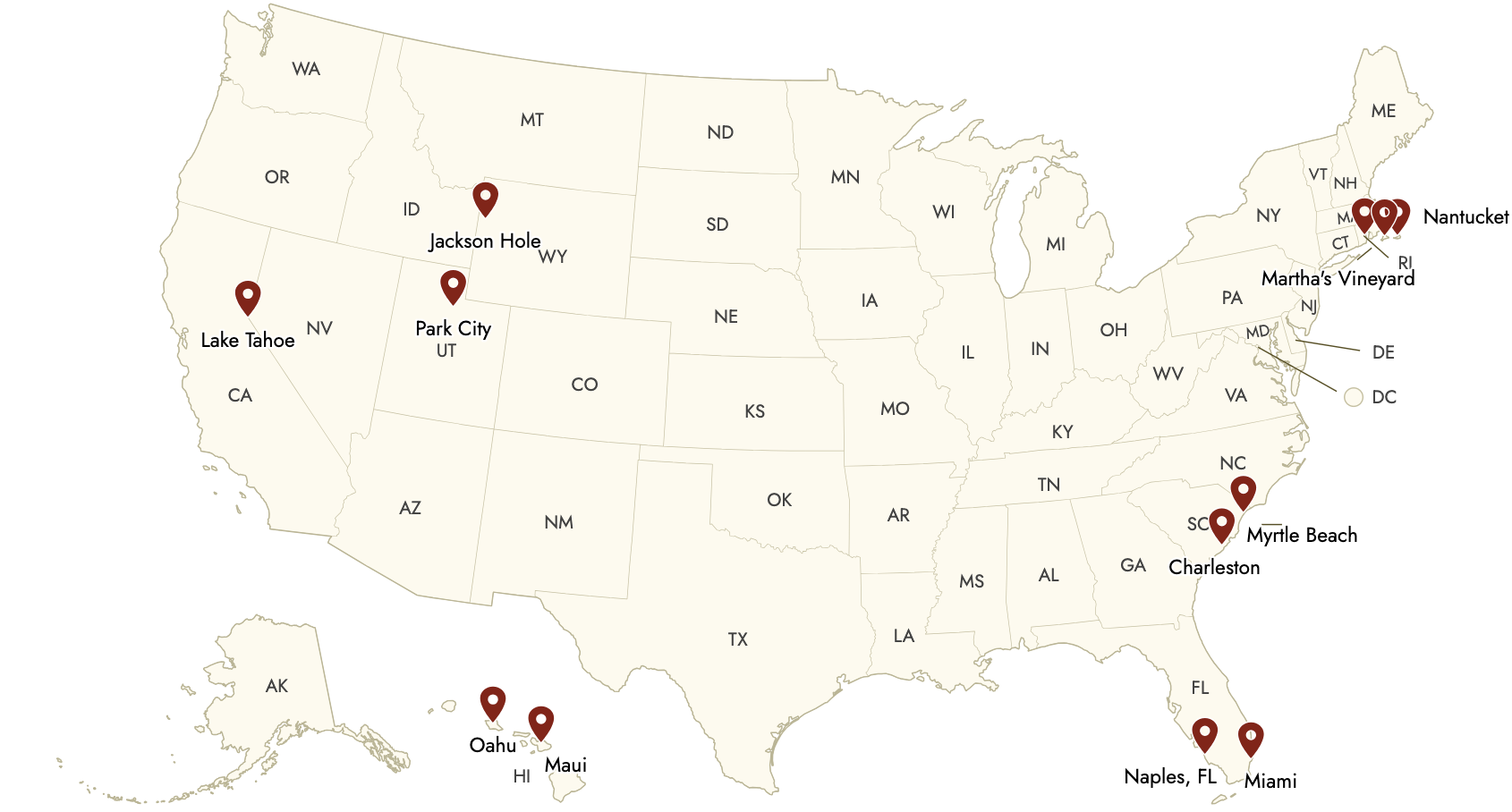
<p class="p2">Within the US, certain destinations consistently pop up on the millionaire radar. Think of it as a mix of classic luxury and outdoorsy adventure:</p>
<figure class="post__image"><img loading="lazy"  src="https://www.onluxy.com/industry-reports-research/media/posts/11/holiday-us.png" alt="" width="1690" height="908" sizes="(max-width: 48em) 100vw, 768px" srcset="https://www.onluxy.com/industry-reports-research/media/posts/11/responsive/holiday-us-xs.png 300w ,https://www.onluxy.com/industry-reports-research/media/posts/11/responsive/holiday-us-sm.png 480w ,https://www.onluxy.com/industry-reports-research/media/posts/11/responsive/holiday-us-md.png 768w"></figure>
<ol class="ol1">
<li class="li9"><strong>Florida's Coasts (Naples, Miami, etc.):</strong> The allure of the Florida coast, particularly around Naples and the West Coast, is undeniable. Miami also remains a popular choice, offering a blend of vibrant city life and beautiful beaches.</li>
<li class="li9"><strong>New England's Coastal Charms (Nantucket, Martha's Vineyard):</strong> For those seeking a more understated elegance, the coastal towns of New England, like Nantucket and Martha's Vineyard, provide a perfect escape. Rhode Island's coastline also holds appeal.</li>
<li class="li9"><strong>Mountain Majesty (Jackson Hole, Park City, Lake Tahoe):</strong> When winter calls, the slopes beckon. Jackson Hole in Wyoming, Park City in Utah, and the Lake Tahoe region straddling California and Nevada offer world-class skiing and stunning scenery.</li>
<li class="li9"><strong>Hawaiian Paradise (Oahu, Maui):</strong> The islands of Hawaii, particularly Oahu and Maui, remain a perennial favorite for their breathtaking landscapes, rich culture, and laid-back atmosphere.</li>
<li class="li9"><strong>Southern Hospitality (Charleston, Myrtle Beach):</strong> The South, specifically around Charleston and Myrtle Beach in South Carolina, offers a blend of history, charm, and beautiful beaches.</li>
</ol>
<p class="p6"> </p>
<p class="p6"> </p>
<p class="p6"><strong> </strong></p>
<p class="p6"> </p>
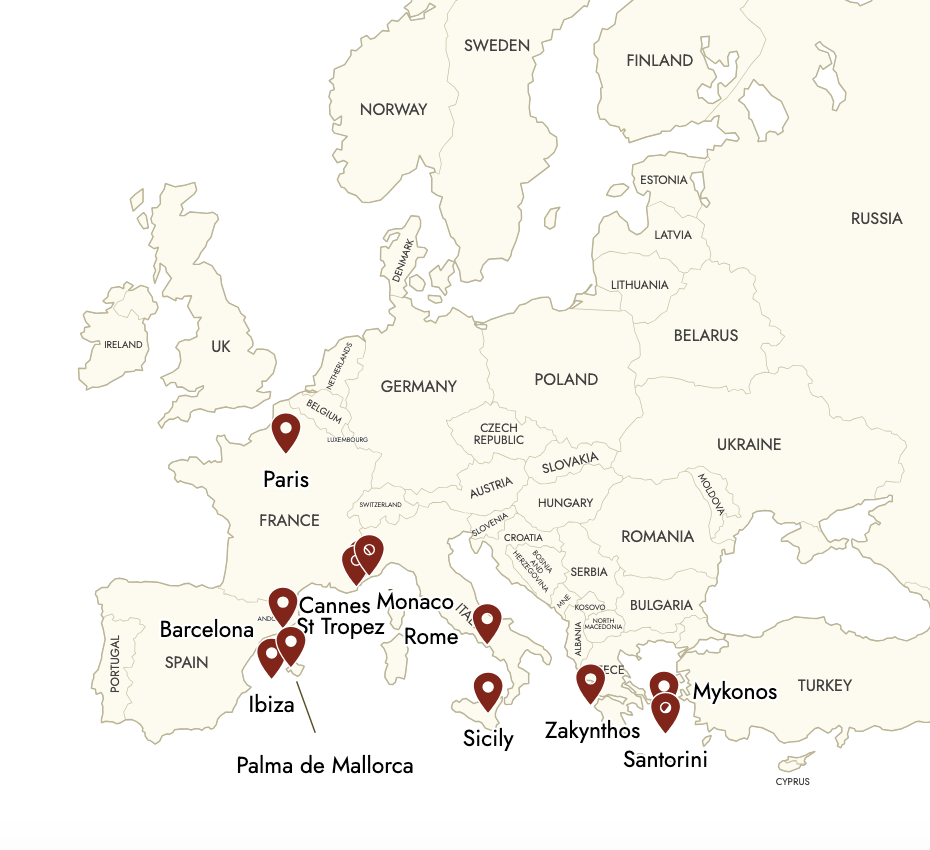
<h4 class="p2"><strong>European Adventures: From Coast to Culture</strong></h4>
<p class="p2">Across the Atlantic, Europe offers a diverse range of experiences that appeal to the discerning traveler:</p>
<figure class="post__image"><img loading="lazy"  src="https://www.onluxy.com/industry-reports-research/media/posts/11/holidays-eu.png" alt="" width="930" height="850" sizes="(max-width: 48em) 100vw, 768px" srcset="https://www.onluxy.com/industry-reports-research/media/posts/11/responsive/holidays-eu-xs.png 300w ,https://www.onluxy.com/industry-reports-research/media/posts/11/responsive/holidays-eu-sm.png 480w ,https://www.onluxy.com/industry-reports-research/media/posts/11/responsive/holidays-eu-md.png 768w"></figure>
<ol class="ol1">
<li class="li9"><strong>French Riviera (Cannes, St. Tropez, Monaco):</strong> The South of France, with its glamorous destinations like Cannes, St. Tropez, and Monaco, continues to be a magnet for the wealthy.</li>
<li class="li9"><strong>Italian Delights (Amalfi Coast, Sicily):</strong> Italy, with its stunning Amalfi Coast and the captivating island of Sicily, offers a blend of natural beauty, rich history, and culinary delights.</li>
<li class="li9"><strong>Greek Island Hopping (Mykonos, Santorini, Zakinthos):</strong> The Greek Islands, with their iconic white-washed villages and crystal-clear waters, provide a picture-perfect escape. Mykonos, Santorini, and Zakynthos are among the most popular choices.</li>
<li class="li9"><strong>City Breaks (Rome, Florence, Venice, Paris, Barcelona):</strong> Classic European cities like Rome, Florence, Venice, Paris, and Barcelona remain popular destinations for their rich history, art, and culture.</li>
<li class="li9"><strong>Balearic Bliss (Ibiza, Palma de Mallorca):</strong> The Balearic Islands, particularly Ibiza and Palma de Mallorca, offer a mix of vibrant nightlife, beautiful beaches, and stunning scenery.</li>
</ol>
<p class="p6"> </p>
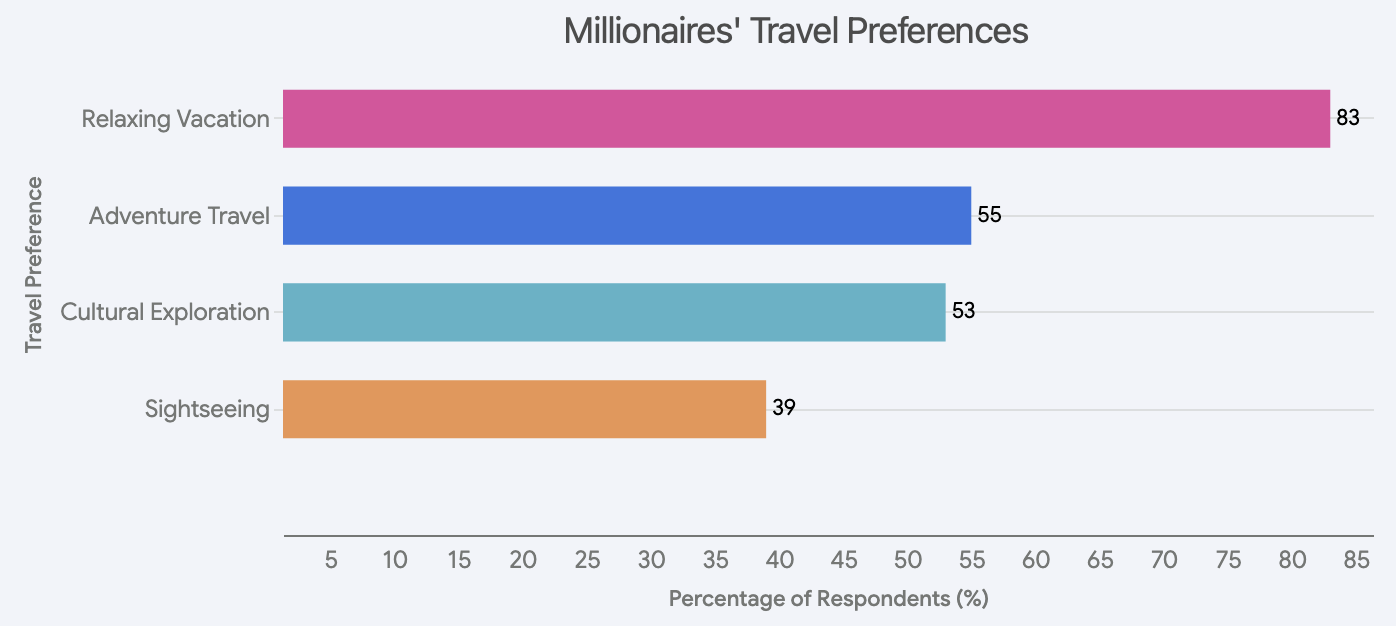
<h4 class="p2"><strong>Relaxation, Adventure, or Culture? Millionaires' Travel Preferences</strong></h4>
<p class="p2">Beyond the "where," it's interesting to consider <i>how</i> millionaires like to travel. A recent survey sheds some light on their preferred vacation styles:</p>
<figure class="post__image"><img loading="lazy"  src="https://www.onluxy.com/industry-reports-research/media/posts/11/millionaires-travel-preference.png" alt="" width="1396" height="626" sizes="(max-width: 48em) 100vw, 768px" srcset="https://www.onluxy.com/industry-reports-research/media/posts/11/responsive/millionaires-travel-preference-xs.png 300w ,https://www.onluxy.com/industry-reports-research/media/posts/11/responsive/millionaires-travel-preference-sm.png 480w ,https://www.onluxy.com/industry-reports-research/media/posts/11/responsive/millionaires-travel-preference-md.png 768w"></figure>
<ul class="ul1">
<li class="li9"><strong>Relaxing Vacation:</strong> A whopping 83% of respondents favored a relaxing vacation. This reinforces the idea that even the busiest among us crave downtime and tranquility.</li>
<li class="li9"><strong>Adventure Travel:</strong> Over half (55%) enjoy adventure travel, suggesting a desire for excitement and pushing boundaries.</li>
<li class="li9"><strong>Cultural Exploration:</strong> A similar percentage (53%) appreciate cultural exploration,<span class="Apple-converted-space">  </span>highlighting a thirst for knowledge and understanding of different cultures.</li>
<li class="li9"><strong>Sightseeing:</strong> While still popular, sightseeing came in at 39%, indicating that while seeing the sights is important, it's often combined with other elements like relaxation or cultural immersion.</li>
</ul>
<p class="p6"> </p>
<p class="p6"> </p>
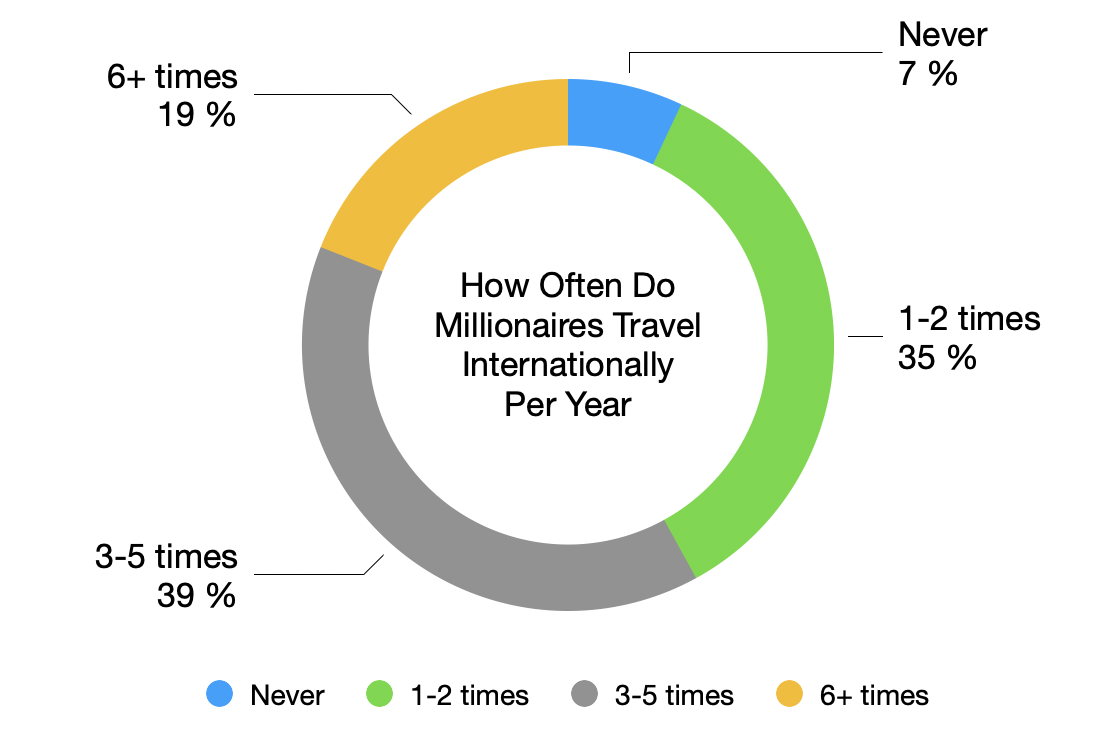
<h4 class="p2"><strong>Frequent Flyers: How Often Do Millionaires Travel?</strong></h4>
<p class="p2">Finally, let's look at travel frequency:</p>
<ul class="ul1">
<li class="li9"><strong>Never:</strong> Only a small percentage (7%) reported never traveling internationally.</li>
<li class="li9"><strong>1-2 Times Per Year:</strong> Just over a third (35%) travel internationally 1-2 times per year.</li>
<li class="li9"><strong>3-5 Times Per Year:</strong> The largest group (39%) travels internationally 3-5 times per year.</li>
<li class="li9"><strong>More Than 6 Times Per Year:</strong> A significant portion (19%) are frequent flyers, traveling internationally more than 6 times per year.</li>
</ul>
<figure class="post__image"><img loading="lazy"  src="https://www.onluxy.com/industry-reports-research/media/posts/11/travel-internationally.png" alt="" width="1118" height="752" sizes="(max-width: 48em) 100vw, 768px" srcset="https://www.onluxy.com/industry-reports-research/media/posts/11/responsive/travel-internationally-xs.png 300w ,https://www.onluxy.com/industry-reports-research/media/posts/11/responsive/travel-internationally-sm.png 480w ,https://www.onluxy.com/industry-reports-research/media/posts/11/responsive/travel-internationally-md.png 768w"></figure>
<p class="p6"> </p>
<h4 class="p2"><strong>The Takeaway: A Blend of Relaxation, Exploration, and Frequent Travel</strong></h4>
<p class="p2">These travel habits paint a picture of millionaires who appreciate both relaxation and exploration. While they have the means to travel anywhere, their choices often reflect a desire for authentic experiences, cultural immersion, and, of course, a bit of well-deserved relaxation. The frequency of their travel, with a large percentage taking multiple international trips per year, underscores their global perspective and appetite for new adventures. It's not just about luxury; it's about experiencing the world.</p>
<p class="p10"> </p>
<h3 class="p3"><strong>3.3 Philanthropy: Giving Back as Part of the Millionaire Lifestyle</strong></h3>
<p class="p2">Beyond accumulating wealth, a significant portion of millionaires actively engage in philanthropic endeavors. According to our survey on Luxy, a notable <strong>82% of millionaire members reported participating in philanthropy</strong>, demonstrating a commitment to giving back to their communities and supporting causes they believe in. This high percentage underscores the importance of social responsibility within this demographic.</p>
<p class="p2">The most prevalent category of philanthropic support, encompassing 52% of respondents, is directed towards religious organizations, poverty relief, education, and disaster aid. This suggests a strong desire among millionaires to address fundamental human needs and support institutions that provide essential services. The focus on local projects within this category is particularly noteworthy. Luxy members often volunteer their time and resources to organizations within their own communities, indicating a personal connection to the causes they support. For example, a millionaire might volunteer at a local soup kitchen, donate to a nearby homeless shelter, or contribute to a religious organization that provides community outreach programs. This hands-on approach suggests a desire to see the direct impact of their contributions.</p>
<p class="p2">Another significant area of philanthropic focus, representing 28% of respondents, is support for other human services, primarily addressing hunger and poverty. Similar to the previous category, these initiatives are often organized and supported locally. This highlights the importance of community-based solutions and the desire to address immediate needs within their own vicinities. The appeal of these organizations likely stems from their direct and tangible impact on individuals and families struggling with basic necessities. Millionaires may be drawn to the opportunity to provide immediate relief and contribute to improving the lives of those less fortunate in their communities.</p>
<p class="p2">Education also emerges as a key area of philanthropic interest, with 23% of respondents supporting educational purposes, such as initiatives that encourage youth participation in STEM (Science, Technology, Engineering, and Mathematics) fields. This demonstrates a forward-looking perspective and a recognition of the importance of investing in future generations. Examples of this type of philanthropy could include funding scholarships for students pursuing STEM degrees, supporting after-school programs that provide STEM education, or donating to organizations that promote STEM literacy in underserved communities. By supporting these initiatives, millionaires are contributing to the development of a skilled workforce and fostering innovation. For instance, a tech entrepreneur might establish a scholarship fund for students pursuing computer science degrees or donate equipment to a local school's robotics program. This type of giving aligns with a desire to promote long-term economic growth and opportunity.</p>
<p class="p2">Finally, 12% of respondents indicated that they volunteer for kids' sports activities, such as coaching or participating in other school programs. While this may seem less directly impactful than other forms of philanthropy, it highlights the importance of community involvement and supporting the development of young people. Coaching a sports team, volunteering at school events, or donating to school programs can have a significant impact on the lives of children, fostering teamwork, leadership skills, and a sense of belonging. This type of philanthropy reflects a desire to contribute to the well-being of their local communities and invest in the future of young people. It also suggests a willingness to contribute their time and expertise, not just their financial resources.</p>
<p class="p2">In conclusion, the philanthropic activities of Luxy's millionaire members reveal a diverse range of interests and a strong commitment to giving back. From supporting basic needs and religious organizations to investing in education and youth development, these individuals are actively engaged in making a positive impact on their communities and the world. The emphasis on local initiatives suggests a desire to see the direct results of their contributions and a personal connection to the causes they support. The high percentage of participation in philanthropy underscores the importance of social responsibility as a core value within this demographic.</p>
<p class="p2">Luxy's millionaires demonstrate a real commitment to improving their communities and the world. They often focus on local initiatives where they can witness the direct impact of their contributions. This hands-on approach suggests that giving back isn't merely an obligation, but a deeply personal desire. They address diverse issues, from immediate needs like hunger and poverty to long-term investments in education, revealing an understanding of complex challenges. Their wealth is viewed not just as personal gain, but as a tool for positive change. This reflects a shift towards a more conscientious view of wealth, where success is measured not only by financial accumulation but also by the positive impact one can make.</p>
<p class="p10"> </p>
<h2 class="p1"><strong>4. Conclusion and Outlook</strong></h2>
<p class="p2">The findings presented in this report provide a clear window into the evolving identity of the modern millionaire. Gone are the days when HNWIs were defined solely by "conspicuous consumption" or static displays of wealth. Today’s affluent demographic, as represented by the Luxy community, is defined by mobility, intellectual curiosity, and a profound commitment to social responsibility.</p>
<h3 class="p3"><strong>4.1 Implications for the Luxury Market and Dating Industry</strong></h3>
<p class="p2">The data suggests a significant shift in the luxury landscape. We are moving toward an era of "Quiet Luxury" and "Experiential Affluence." <br><br>With 43% of members prioritizing travel and 29% focusing on fine dining, the luxury market must pivot from selling "things" to selling "access" and "narratives." High-end brands should focus on the <i>story</i> and the <i>experience</i> rather than the price tag.</p>
<ul class="ul1">
<li class="li2"><strong>The Rise of Conscious Dating:</strong> In the dating industry, wealth is no longer the sole gatekeeper. The high participation in philanthropy (82%) and self-improvement (23%) indicates that HNWIs are looking for value-alignment. Users are seeking partners who don't just share a tax bracket, but who share a commitment to local community impact and lifelong learning.</li>
<li class="li2"><strong>Geographical Agility:</strong> The concentration of wealth in "tax havens" like Florida and "lifestyle hubs" like Italy highlights a "digital nomad" trend among the elite. The dating industry must adapt to a user base that is frequently international, traveling frequently, requiring seamless cross-border connectivity.</li>
</ul>
<h3 class="p3"><strong>4.2 What This Means for Luxy</strong></h3>
<p class="p2">For Luxy, these trends confirm that the platform is more than a dating app, a lifestyle ecosystem. The high concentration of millionaire users in specific “hotspots”, such as California and London, provides Luxy with a roadmap for localized engagement. Furthermore, the almost humble passions of millionaire (gardening, tennis, learning) suggests that Luxy should continue to focus on authenticity and shared passions rather than just exclusive images.</p>
<p class="p2">As we look toward the 2030s, the Luxury Lifestyle will be defined by the impact a person leaves on the world, not just the assets they accrue. Luxy is uniquely positioned to be the premier architect of these high-value connections. By fostering an environment where wealth meets purpose, Luxy will continue to attract the world’s most influential individuals, ensuring that for its users, the best is always yet to come.</p>
<p class="p8"> </p>
<p class="p10"> </p>
<p class="p8"> </p>
            ]]>
        </content>
    </entry>
    <entry>
        <title>2025 Scam Prevention Report</title>
        <author>
            <name>Dr. Max Langdon</name>
        </author>
        <link href="https://www.onluxy.com/industry-reports-research/scam-prevention-report-2025.html"/>
        <id>https://www.onluxy.com/industry-reports-research/scam-prevention-report-2025.html</id>
        <media:content url="https://www.onluxy.com/industry-reports-research/media/posts/10/Scam-Prevention-Dating.jpg" medium="image" />

        <updated>2025-12-12T09:29:47+08:00</updated>
            <summary type="html">
                <![CDATA[
                        <img src="https://www.onluxy.com/industry-reports-research/media/posts/10/Scam-Prevention-Dating.jpg" alt="" />
                    Luxy could uncover a dramatic shift in its 2025 Scam Prevention Report, showing activities earlier from individual fraudsters to now&hellip;
                ]]>
            </summary>
        <content type="html">
            <![CDATA[
                    <p><img src="https://www.onluxy.com/industry-reports-research/media/posts/10/Scam-Prevention-Dating.jpg" class="type:primaryImage" alt="" /></p>
                <p>Luxy could uncover a dramatic shift in its 2025 Scam Prevention Report, showing activities earlier from individual fraudsters to now highly organized, professional crime syndicates, preying on the aspirations of high-net-worth individuals. It’s long no longer about broken hearts and a few bucks lost, it's about sophisticated financial exploitation on a global scale.</p>
<h3 class="p1"><strong>1. Introduction to Fraudulent Activities in 2025 </strong></h3>
<p class="p2">The digital landscape offers an abundance of opportunities for people to connect easily online. May it for finding the love of their lives, establish partnerships, or build friendships, online dating apps, in particular, have become a primary way for millions of singles seeking looking for like-minded individuals. And they are convenient and efficient. Within minutes, you can strike up conversations with interesting new people. However, this convenience also attracts a growing number of people with ill intentions. Scammers, always on the lookout to connect more victims, target in 2025 all online dating platforms, preying on universal human emotions and aspirations. This report takes a closer look at the changed online fraud, specifically examining the trends security experts on Luxy have observed and how Luxy employs strategies to proactively protect its members from these threats.</p>
<p class="p2">Luxy could reveal a significant and concerning shift in scam methodologies: from the individualistic romance scams of the past, we now face highly organized, professional operations predominantly focused on cryptocurrency and investment fraud, with a staggering 75% of these sophisticated attempts originating from specific regions in South Asia. These modern scammers are masters of psychological manipulation, employing emotional tricks to gain rapport and carry out schemes with faking “expert insights” and unique niche knowledge, to elaborate "passive income" opportunities, and pressuring users to quickly move conversations off-platform to evade detection.</p>
<p class="p2">In light of this escalating threat, Luxy has continuously upgraded its defense mechanisms. Luxy shares some of its scam detection mechanisms and how threats are addressed. Through a data-driven approach, Luxy can monitor suspicious actions across account creation, messaging, and user behavior. The Luxy system makes use of real-time location verification, collaborative intelligence with industry partners for blacklisting known scammer assets, and advanced messaging pattern analysis. Crucially, these technological defenses are augmented by a dedicated human review team, ensuring comprehensive oversight.</p>
<p class="p2">The robust scam prevention actions on Luxy are impressive: user safety is our priority, and result in over 95% of fraudulent actions and scam attempts being detected and neutralized before they can cause any harm to Luxy members. Through integration of<span class="Apple-converted-space">  </span>technology, human expertise, and proactive user empowerment, Luxy remains dedicated to secure a trustworthy environment where genuine connections can flourish, free from the threat of online fraud.</p>
<p class="p3"> </p>
<h3 class="p1"><strong>2. Decoding 2025’s Online Dating Scam Trends </strong></h3>
<p class="p2"><strong> </strong></p>
<h4 class="p3"><strong>2.1 Scam Trends Monitored by Luxy </strong></h4>
<p class="p4">Online dating platforms provide a great and fast way to connect with new people, but also, unfortunately, open doors for unwanted danger. Fraudsters have long since realized that as well, preying on human emotions and aspirations. Since Luxy is a dating app predominantly used by HNWIs and millionaires, it was always seen as a tempting target for scammers. Recognizing this inherent risk, Luxy established in its founding year a state of the art security system and has always enhanced its scope. Not only to block suspicious attacks but also to carefully review a member base, aiming to identify risk early on before they occur.</p>
<p class="p4">In Luxy's early years, the landscape of scam attempts was characterized by a more individualistic approach. Fraudsters, often real people who had passed Luxy's picture verification, primarily engaged in classical romance scam tactics. This involved building trust and emotional rapport, only to later introduce an emergency or a compelling sob story, culminating in a request for financial assistance. These attempts were relatively scattered, with approximately 60% of all scam attempts falling into this category. Other fraudulent activities included false job offers (around 15%), attempts at identity theft (10%), and smaller-scale scams such as requests for gifts or gift cards (10%), after which the scammer would abruptly disappear and false investments at 5%.</p>
<figure class="post__image"><img loading="lazy"  src="https://www.onluxy.com/industry-reports-research/media/posts/10/Image-Scam-Evolution.jpg" alt="" width="1592" height="1174" sizes="(max-width: 48em) 100vw, 768px" srcset="https://www.onluxy.com/industry-reports-research/media/posts/10/responsive/Image-Scam-Evolution-xs.jpg 300w ,https://www.onluxy.com/industry-reports-research/media/posts/10/responsive/Image-Scam-Evolution-sm.jpg 480w ,https://www.onluxy.com/industry-reports-research/media/posts/10/responsive/Image-Scam-Evolution-md.jpg 768w"></figure>
<p class="p1">However, since 2020, Luxy has observed a significant and concerning shift towards more organized and professional scam operations. This evolution reflects a broader industry<span class="Apple-converted-space">  </span>trend where individual opportunism has given way to sophisticated, team-based fraud, consolidated in company-like structures. Now in 2025, the vast majority of scam attempts fall into the category of<span class="Apple-converted-space">  </span>investment and cryptocurrency scams. They dominate the list of around 70% of all fraudulent activities. These highly professional operations often involve complex narratives designed to lure victims into fake investment schemes. Classical romance scams, while still present, have diminished significantly, now representing only about 15% of scam attempts. The remaining threats include a smaller percentage of strange and fake job offers (5%) and requests for sensitive personal identity documents, such as passports, indicating a persistent focus on identity theft (5%). This data clearly illustrates a strategic pivot by fraudsters from emotional manipulation for direct financial aid to more intricate, high-value financial exploitation schemes.</p>
<p> </p>
<h4 class="p1"><strong> 2.2. Analysis of Common Scam Behaviors in 2025</strong></h4>
<p class="p2">The modern scammer is no longer a lone wolf operating in the shadows; they are often part of organized groups, exhibiting a level of sophistication that far surpasses the rudimentary attempts of a decade ago. This shift towards professionalized approaches of has led to more nuanced behaviors and meticulously crafted narratives designed to exploit specific vulnerabilities. Since 2020, these tactics have been increasingly subtle, leveraging psychological tricks and preying on the aspirations and emotional needs of people.</p>
<p class="p2">Luxy has uncovered their activities now in 2025 and can provide invaluable first-hand information of these emerging scam tactics. From our security team and user insights we gain crucial insights into the evolving patterns and common red flags that signal potential scams. While the most damaging scam attempts and messaging usually occur off the Luxy platform, once users have exchanged contact details to continue conversations, these user insights are critical for understanding the full scope of the threat.</p>
<p class="p2">Recognizing a few key indicators or talking points early can be the most effective defense against falling victim to sophisticated scams. These are not merely suggestions but critical red flags that demand attention. The following are the most common indicators that prevent being scammed everyone easily can familiarize.</p>
<p> </p>
<h5 class="p1"><strong>a. The Fairytale of "Passive Income": Cryptocurrency and Investment Opportunities</strong></h5>
<p class="p1">This remains the most prominent and dangerous scam in 2025, directly linked to the rise of "pig butchering" schemes. Scammers initiate conversations by casually mentioning their success with "passive income" or other lucrative investment strategies. They present themselves as a friendly guide, "sharing" their knowledge of a "secret" or "guaranteed" investment, often in cryptocurrency, forex, or other digital assets. They might share convincing screenshots of fake profits or discuss complex financial jargon to appear legitimate. The insidious trap lies in leading victims to fake investment platforms, entirely controlled by these fraudsters. Once funds are sent, victims find themselves unable to withdraw their money, it simply vanishes.<br><strong>How to react:</strong> Any unsolicited mention of investment opportunities or cryptocurrency, especially early in a conversation, should be treated as an immediate and severe warning sign. Especially when on a dating platform, you are here to get to know someone’s<span class="Apple-converted-space">  </span>characteristics what they are looking for in a relationship and not to learn investment tricks. Don’t be fooled by their tactics. They want to get you to invest on a fake platform and besides casual talk will keep circling back to that topic. Cease communication and block the contact. </p>
<h5 class="p1"><strong>b. The Rush to Leave the Platform: Requests to Switch to External Messaging</strong></h5>
<p class="p1">This tactic is a cornerstone of almost every scam. Its purpose is clear: to move the conversation off Luxy's (and other dating apps') monitored platform, where scammer behavior and keywords are actively detected. Scammers will often express a desire for "more personal" or "faster" communication, suggesting WhatsApp, Telegram, Instagram or direct texting (with a simple purchased VOIP number). They might claim to be too busy for the app, or that their subscription is ending soon.<br><strong>How to react:</strong> Users should resist any pressure to move off-platform prematurely. Don’t accept excused like, “I am rarely here” or “It’s easier to talk elsewhere”. They made an effort to create a profile, so they also are able to stay on the app to talk. Legitimate connections will understand the need to build trust within the secure environment of Luxy or other dating platforms. Scammers are often reported and banned within hours on Luxy, especially if they send similar messages or are flagged by multiple users. If users remain on the platform, communication is cut upon a ban, keeping them safe.</p>
<h5 class="p1"><strong>c. The Fabricated Persona: Inconsistent or Vague Personal Details</strong></h5>
<p class="p1">Scammers often juggle multiple fake identities, and while their stories can be polished, they frequently contain cracks under scrutiny. They might provide conflicting information about their job, location, family, or past experiences. They tend to be evasive when asked for specific details or offer generic, stock answers. A common tell is their lack of knowledge about the town they supposedly reside in, making mistakes with local time zones, or trying to change the subject when pressed. Their job descriptions, if pushed for explanation, often sound fishy or overly generalized.<br><strong>How to react:</strong> Pay close attention to discrepancies. A simple cross-reference of details mentioned in different conversations can quickly reveal inconsistencies and expose a fabricated identity.</p>
<h5 class="p1"><strong>d. The Whirlwind Romance: "Love Bombing" and Intense Emotional Connection Too Soon</strong></h5>
<p class="p1">Scammers are masters of emotional manipulation, aiming to create a strong emotional bond rapidly to bypass rational thought. They will declare deep affection, proclaim "soulmate" connections, or make elaborate future plans (marriage, moving in together) within days or weeks of initial contact, often without ever having met in person or even video called. They meticulously mirror the user's interests and desires, creating an intense, almost overwhelming sense of connection. Despite these grand plans, they consistently avoid any direct contact, even video calls, while still making promises to meet "soon."<br><strong>How to react:</strong> Be wary of anyone who seems "too good to be true" or rushes emotional intimacy. Genuine relationships develop organically over time, not in a hyper-accelerated fantasy.</p>
<h5 class="p1"><strong>e. The Elusive Figure: Refusal or Constant Excuses for Not Video Calling or Meeting in Person</strong></h5>
<p class="p1">This is a classic and undeniable indicator of catfishing or a scammer whose profile does not match their true identity. They will have an endless string of excuses: "bad internet," "camera broken," "on a business trip in a remote area," "too shy," or "waiting for the perfect moment." They might even make plans to meet in person, only to conjure up last-minute, often dramatic, excuses why the date or physical meeting cannot take place.<br><strong>User Action:</strong> Insist on a video call to verify identity. If they consistently refuse or make endless excuses, it's a major red flag. If someone is unwilling to meet you in person or makes repeated excuses, they are likely not genuinely interested in a dating relationship, and communication should be ended.</p>
<h4 class="p1"><strong> 2.3. Psychological Manipulation Tricks</strong></h4>
<p class="p2">Fraudsters are not just opportunistic, in 2025 they are professionally organized, masters of psychological manipulation, oozing fundamental emotional triggers to achieve their illicit goals.</p>
<ul class="ul1">
<li class="li1"><strong>Exploiting Loneliness and Desire for Connection:</strong> At the core of many scams is the targeting of individuals looking for a genuine connection. Fraudsters provide intense attention, validation, and a seemingly perfect match, effectively filling an emotional void and creating a powerful bond built on false pretenses.</li>
<li class="li1"><strong>Leveraging Empathy and Altruism:</strong> They craft elaborate sob stories or sudden crises, a sick family member, a lost wallet, a lawsuit, a lost passport while abroad specifically designed to elicit sympathy and a desire to help. This tactic is particularly effective with compassionate individuals who genuinely want to alleviate suffering.</li>
<li class="li1"><strong>Tapping into Aspirations:</strong> For HNWIs, scammers often appeal to desires for further financial growth, unique investment opportunities, self improvement and a door opener to exclusive social circles. They frame their scam as a pathway to greater success, wealth, or an elevated lifestyle, making the scheme seem like a legitimate opportunity.</li>
<li class="li1"><strong>Creating a Sense of Scarcity or Urgency:</strong> Scammers skillfully instill a fear of missing out (FOMO) or a pressing need for immediate action. Whether it's an "expiring" investment opportunity or an "urgent" financial crisis, this pressure bypasses rational decision-making, forcing victims to act impulsively.</li>
<li class="li1"><strong>Building a Shared Identity:</strong> They quickly identify and mirror the victim's values, interests, and aspirations. This creates a powerful illusion of deep compatibility and understanding, making the victim believe they have found someone truly special who "gets" them.</li>
</ul>
<h4 class="p1"><strong>2.4. Trust Building Scam Strategies: The Art of Deception </strong></h4>
<p class="p2">The foundation of any successful scam is the creation of trust, no matter how false. Scammers employ sophisticated strategies to build this deceptive bond:</p>
<ul class="ul1">
<li class="li1"><strong>Mirroring and Pacing:</strong> Scammers carefully observe and imitate the victim's communication style, interests, emotional responses, and even life goals. This creates an artificial sense of rapport and deep connection, making the victim feel profoundly understood and compatible with the scammer.</li>
<li class="li1"><strong>Fabricated Vulnerability:</strong> To appear relatable and trustworthy, scammers often share "personal" stories of past hardship, betrayal, or loneliness. These fabricated vulnerabilities are designed to elicit empathy and encourage the victim to reciprocate by sharing their own intimate details, deepening the false bond.</li>
<li class="li1"><strong>Consistent, High-Frequency Communication:</strong> They bombard the victim with messages, calls, and expressions of affection, establishing a constant presence in their life. This high-frequency interaction rapidly deepens the perceived emotional bond, making the relationship feel more real and significant than it actually is.</li>
<li class="li1"><strong>Future Pacing:</strong> Scammers frequently discuss elaborate future plans, travel together, how life will look like when they finally meet, shared business ventures, or even moving in, to solidify the emotional investment. These discussions make the relationship feel special, real and long-term, further entrenching the victim's commitment.</li>
<li class="li1"><strong>"Expert" Persona:</strong> Especially prevalent in investment scams, they project an image of financial success and someone smart with exclusive niche knowledge. They position themselves as a trusted guide to wealth, offering to "help" the victim achieve financial success through their "proven" methods.</li>
</ul>
<h3 class="p1"><strong>3. Scam Trends: Origins &amp; Classification </strong></h3>
<p class="p2">Understanding the operational landscape of scammers is crucial for effective prevention. Luxy's robust monitoring systems and invaluable user reports provide a unique window into where these scams originate and how they manifest on the platform. This chapter delves into the geographical origins of scam attempts and the specific tactics employed, offering insights derived directly from Luxy's data.</p>
<h4 class="p1"><strong><span class="Apple-converted-space"> </span>3.1. Where Are They Launched From and What Type of Scams Are They?</strong></h4>
<p class="p2">While professional scammers employ sophisticated methods to mask their true locations, including proxy servers, occasional slip-ups or patterns in network traffic allow Luxy to trace their general origin. These insights reveal a distinct geographical distribution, often correlating with specific scam methodologies.</p>
<p class="p2">Our data indicates that the majority of scam attempts targeting Luxy users originate from a few key regions:</p>
<figure class="post__image"><img loading="lazy"  src="https://www.onluxy.com/industry-reports-research/media/posts/10/Image-Scam-Location.png" alt="" width="1796" height="1344" sizes="(max-width: 48em) 100vw, 768px" srcset="https://www.onluxy.com/industry-reports-research/media/posts/10/responsive/Image-Scam-Location-xs.png 300w ,https://www.onluxy.com/industry-reports-research/media/posts/10/responsive/Image-Scam-Location-sm.png 480w ,https://www.onluxy.com/industry-reports-research/media/posts/10/responsive/Image-Scam-Location-md.png 768w"></figure>
<ul class="ul1">
<li class="li1"><span class="s1"><strong>South Asia (Roughly 75% of detected scams)</strong> </span><br>This region is a significant hub for organized scam operations which are located in the<span class="Apple-converted-space">  </span>countries listed below.<br><strong>Cambodia (30%), Myanmar (25%), Laos (15%):</strong> These countries, located in a triangle in Southeast Asia, have become notorious centers for large-scale, organized online fraud operations, often involving forced labor. Economic conditions, coupled with lax regulations and the presence of organized crime syndicates, create fertile ground for these activities. Scammers here often operate from dedicated "scam compounds" or call centers, running highly professionalized schemes.<br><strong>Thailand (5%) and Philippines (5%):</strong> While also present, these locations show less scam activities compared to their neighbors, mainly for being more stable. However, similar sophisticated operations originate from here.<br><br></li>
<li class="li1"><span class="s1"><strong>Central Africa (roughly 10% of detected scams)</strong><br></span><strong>Ghana, Nigeria, Central African Republic, Ivory Coast:</strong> These nations have long been associated with online fraud, often due to economic disparities and established networks of cybercriminals. The infrastructure for simpler romance type scams is well-entrenched.<br><strong><br></strong></li>
<li class="li1"><span class="s1"><strong>Russia and Ukraine (roughly 10% of detected scams)</strong><br></span>The geopolitical situation and a strong existing cybercrime ecosystem contribute to these regions being sources of scam activity. Highly skilled individuals, sometimes operating independently or in smaller groups, leverage their technical prowess.<br><span class="s1"><strong><br></strong></span></li>
<li class="li1"><span class="s1"><strong>Turkey and Cyprus (roughly 5% of detected scams)</strong><br></span>These locations, often acting as transit points or regional hubs, show a smaller but distinct pattern of scam types.</li>
</ul>
<h4 class="p1"><strong> 3.2. The Interesting Pattern: Scam Types by Location</strong></h4>
<p class="p2">The geographical origin often correlates with the type and sophistication of the scam, reflecting local expertise, resources, and target demographics:</p>
<ul class="ul1">
<li class="li2"><strong>South Asia (Cambodia, Myanmar, Laos, Thailand, Philippines): Exclusively Sophisticated Investment Scams (Investment Scams)</strong></li>
</ul>
<p class="p3">Scammers from these regions almost exclusively focus on highly sophisticated investment scams, commonly known as "pig butchering”. These are elaborate, long-term cons designed to build deep emotional trust before convincing victims to invest large sums in fake platforms. The "why" here is multi-faceted: these operations are often run by large, organized syndicates with significant resources, including technical infrastructure for creating fake trading platforms and training for psychological manipulation.</p>
<ul class="ul1">
<li class="li1"><strong>Central Africa (Ghana, Nigeria, Central African Republic, Ivory Coast): Simpler Romance Scams </strong></li>
</ul>
<p class="p2">Scam attempts from Central Africa tend to be simpler, focusing primarily on classic romance scams. These often involve fake profiles designed to elicit emotional attachment quickly, followed by requests for money due to fabricated emergencies (e.g., medical bills, travel expenses). The "why" is often linked to economic desperation and a well-established history of these types of scams, which require less technical infrastructure than investment scams but rely heavily on emotional manipulation and a high volume of attempts.</p>
<p class="p3"> </p>
<ul class="ul1">
<li class="li1"><strong>Russia and Ukraine: Investment Scams and Gift Requests via Sob Stories</strong></li>
</ul>
<p class="p2">Scammers from Russia and Ukraine engage in a mix of investment scams (though perhaps less frequently than South Asian groups) and scams involving requests for gifts or financial aid via elaborate sob stories. These narratives often leverage personal hardship, medical emergencies, or travel difficulties. This results due to a lack of economic possibilities, a high level of technical literacy, and a cultural context where direct appeals for help might be more common (e.g. women wanting to be courted), making these narratives resonate.</p>
<ul class="ul1">
<li class="li1"><strong>Turkey and Cyprus: Identity Theft (Passport Info)</strong></li>
</ul>
<p class="p2">Scams originating from Turkey and Cyprus more often involve requests for real personal information, such as passport details, which are then used for identity theft. This could be due to regional expertise in document forgery, access to networks for selling stolen identities, or a strategic focus on exploiting personal data for various illicit purposes beyond direct financial transfer.</p>
<h4 class="p1"><strong> 3.3. Analysis of Scam Behavior on Dating Platforms</strong></h4>
<p class="p2">Scammers understand that their window of opportunity on platforms like Luxy is often limited. Their activities are therefore highly strategic, focusing on quickly establishing contact and moving off-platform. Let’s take a further look at their practical management of online profiles and messaging patterns.</p>
<p class="p3"> </p>
<h6 class="p2"><strong>Account Creation and Profile Management:</strong></h6>
<ul class="ul1">
<li class="li4"><strong>Recruitment of Real People &amp; AI Assistance:</strong> Scammers often recruit real individuals to create profiles, using their genuine photos and basic details to bypass initial security checks on dating platforms. This makes detection challenging, as the profile itself appears authentic and is successfully verified. In more advanced operations, sophisticated programs and AI are employed to generate highly convincing fake profiles, complete with AI-generated images and biographies that mimic legitimate users. These AI-powered profiles are constantly evolving to evade detection.</li>
<li class="li4"><strong>Distinguishing Fake from Real:</strong> To the human eye, these fake profiles can be incredibly difficult to distinguish from real ones. They often feature attractive, high-quality photos and well-crafted, albeit generic, biographies. However, Luxy's advanced detection systems analyze input patterns, metadata, behavioral<span class="Apple-converted-space">  </span>anomalies, and cross-reference information that a human might miss, allowing the system to flag and often bar these inauthentic accounts.</li>
</ul>
<h6 class="p2"><strong>Messaging Patterns and Objectives:</strong></h6>
<ul class="ul1">
<li class="li4"><strong>The Race for Contact Information:</strong> The primary objective of a scammer once a profile is active on Luxy is to obtain the victim's phone number or other social media contacts (e.g. WhatsApp, Telegram, Instagram) as soon as possible. This urgency stems from the understanding that their activity on Luxy is usually based on a limited time window.</li>
<li class="li4"><strong>Limited Time Window:</strong> Scammers know that their profiles are under constant scrutiny. They anticipate being reported and banned, often within hours or days, especially if they send similar messages to multiple users or trigger specific keywords. Therefore, their strategy is to quickly establish rapport, make a compelling case for moving off-platform, and secure external contact details before Luxy's moderation team can intervene.</li>
<li class="li4"><strong>Off-Platform Operation:</strong> Once the conversation moves off Luxy, the scammer operates without the platform's oversight, making it significantly harder for Luxy to monitor, intervene, or gather evidence. This is why users are consistently advised to remain on the platform until a genuine level of trust is established.</li>
</ul>
<h4 class="p1"><strong> 3.4. System Enhancements for Scam Detection</strong></h4>
<p class="p2">Recognizing the evolving sophistication of scammers, Luxy has invested heavily in state-of-the-art detection and prevention systems. These technological advancements, combined with human oversight, form a multi-layered defense designed to protect users proactively.</p>
<p class="p3"> </p>
<h5 class="p4"><strong>Overview of Luxy's Enhanced Scam Detection Systems and Technologies</strong></h5>
<p class="p2">Luxy employs a sophisticated, multi-faceted system that continuously monitors for suspicious actions across various touch points, including account creation, messaging content, and behavioral patterns.</p>
<ul class="ul1">
<li class="li2"><strong>Real-time Location Verification:</strong> One of the most effective proactive measures is Luxy's ability to cross-reference user location data. The system meticulously checks the real-time IP address of a user against their phone's geo-location data. If a significant mismatch is detected – for instance, an IP address indicating a user is in one country while their device's GPS places them in another – the profile is immediately flagged and often banned. This mechanism directly combats scammers' attempts to mask their true origin using VPNs or other anonymization tools, ensuring that users are genuinely where they claim to be.</li>
<li class="li2"><strong>Collaborative Intelligence and Blacklisting:</strong> Luxy doesn't operate in isolation. We<span class="Apple-converted-space">  </span>actively collaborate with other platforms and industry partners to identify confirmed scammers early on. This shared intelligence allows us to preemptively blacklist individuals or groups known for fraudulent activities. Furthermore, Luxy maintains its own extensive knowledge-based database. If blacklisted devices, specific locations, IP addresses, or even images have been previously associated with scam attempts, they are permanently blocked from being used again on the platform. This creates a powerful deterrent, making it increasingly difficult for repeat offenders to re-enter the Luxy ecosystem.</li>
<li class="li2"><strong>Advanced Messaging Pattern Analysis:</strong> Our systems continuously analyze messaging patterns for keywords, phrases, and behavioral anomalies indicative of scamming attempts. This includes detecting pressure to move off-platform, requests for personal information, or the use of "love bombing" language too early in a conversation.</li>
<li class="li2"><strong>Dedicated Review Team:</strong> Complementing our technological defenses is a dedicated and highly trained review team. This team constantly checks flagged activities, investigates user reports, and intervenes swiftly. Their human intuition and understanding of nuanced scam tactics allow them to catch sophisticated attempts that might initially bypass automated systems. This combination of AI-driven detection and human expertise ensures comprehensive coverage and rapid response.</li>
</ul>
<h5 class="p1"><span class="s1"><strong> </strong></span><strong>How Luxy’s Anti-Scam Measures Proactively Prevent Scams</strong></h5>
<p class="p2">These integrated systems work synergistically to prevent scams before they can cause harm:</p>
<ol class="ol1">
<li class="li3"><strong>Deterrence at Entry:</strong> By blacklisting known scammer assets (IPs, devices, images), Luxy prevents many fraudulent actors from even creating an account or gaining a foothold on the platform.</li>
<li class="li3"><strong>Early Detection &amp; Elimination:</strong> The real-time location checks and advanced messaging analysis allow Luxy to identify and ban suspicious profiles often within hours of their creation or first interaction. This significantly limits the scammer's "window of opportunity" to engage with legitimate users.</li>
<li class="li3"><strong>Disruption of Communication:</strong> By flagging and intervening in suspicious conversations, Luxy disrupts the scammer's primary goal: to move the interaction off-platform. This keeps users within Luxy's monitored environment, where they are safer.</li>
<li class="li3"><strong>Continuous Learning:</strong> Every detected scam attempt, every blacklisted asset, and every user report feeds back into the system, refining our algorithms and enhancing our ability to predict and prevent future threats.</li>
</ol>
<p class="p4"> </p>
<p class="p4"> </p>
<h5 class="p1"><strong>Impact of System Improvements on Scam Prevention Rates </strong></h5>
<p class="p2">The rigorous implementation and continuous refinement of these system enhancements have yielded remarkable results. Luxy's data indicates that <strong>over 95% of fraudulent actions and scam attempts are now detected and neutralized before they can create any harm to Luxy users.</strong> This high prevention rate underscores the effectiveness of our proactive defense strategy, providing a significantly safer environment for our community. While no system can guarantee 100% immunity, this figure demonstrates Luxy's commitment to staying ahead of evolving scam tactics and protecting our members.</p>
<p class="p5"> </p>
<h5 class="p1"><strong>Luxy's Education Initiatives</strong></h5>
<p class="p2">Beyond technological safeguards, Luxy believes in empowering its users with the knowledge to protect themselves. Education is a critical component of our anti-scam strategy:</p>
<ul class="ul1">
<li class="li3"><strong>Contextual Prompts and Warnings:</strong> When our systems detect suspicious messages or keywords within a conversation, such as requests to switch to an external messaging app, mentions of investment opportunities, or attempts to solicit personal financial details, Luxy provides immediate, contextual prompts to the user. These in-app warnings serve as a real-time reminder of potential risks, advising users against sharing personal information or moving off-platform prematurely.</li>
<li class="li3"><strong>Preventative Guidance:</strong> These prompts are designed to be clear and actionable, guiding users on best practices. For example, a prompt might appear stating, "Warning: Scammers often try to move conversations off Luxy. Please be cautious about sharing personal contact information or switching to other apps." This direct guidance helps users recognize red flags themselves and reinforces safe online behavior.</li>
<li class="li3"><strong>Reinforcing Platform Security:</strong> By educating users on the risks associated with moving off-platform, Luxy reinforces the value of its secure and monitored environment. Users are encouraged to remain within the app until they have established a genuine level of trust, ensuring that Luxy's protective measures can continue to safeguard their interactions.</li>
</ul>
<p class="p6"> </p>
<p class="p2">This multi layer approach, combining advanced technology with vigilant human oversight and proactive user education, forms the foundation of Luxy's commitment to maintaining a secure and trustworthy platform for its high-net-worth community.</p>
<p> </p>
<h3 class="p1"><strong>4. Outlook Forging a Future of Trust and Connection: </strong></h3>
<p class="p3">The landscape of online connection is constantly evolving, and with it, the challenges posed by malicious actors. Effective scam prevention is not merely a reactive measure but a proactive, continuous commitment. For users, it means cultivating a healthy skepticism, understanding common red flags – such as requests for money, overly rapid declarations of love, or attempts to move conversations off-platform immediately – and utilizing the reporting tools provided by platforms. Education and vigilance remain the most powerful personal defenses. For platforms, it necessitates a multi-layered defense strategy: sophisticated AI and machine learning algorithms for real-time threat detection, rigorous human moderation, robust identity verification processes, and transparent reporting mechanisms. The most successful prevention strategies are those that foster a partnership between the platform and its informed user base.</p>
<p class="p3">At Luxy, this commitment to user safety is not just a feature; it is fundamental to our mission. We understand that our discerning members seek not just connections, but secure and genuine connections. Our dedication is unwavering, manifested through continuous investment in cutting-edge security technologies, the deployment of advanced behavioral analytics to identify suspicious patterns, and the tireless work of our dedicated safety teams. We are constantly refining our protocols, adapting to new scam methodologies, and collaborating with industry experts to ensure that Luxy remains a sanctuary for authentic relationships. Our promise is to provide an environment where trust can flourish, allowing our members to focus on what truly matters: building meaningful connections without the pervasive fear of fraud.</p>
<p class="p3">Looking ahead, the value of the online dating industry is inextricably linked to its ability to guarantee user safety. In an era where digital interactions are increasingly central to human connection, platforms that prioritize and effectively deliver security will be the ones that thrive. Trust is the ultimate currency, and a reputation for robust scam prevention not only attracts new users but also fosters loyalty and advocacy among existing ones. This commitment elevates the entire industry, moving it beyond past stigmas and solidifying its role as a legitimate and invaluable avenue for relationship formation. For platforms like Luxy, leading the charge in security innovation sets a benchmark, contributing to a healthier, more credible online dating ecosystem overall. The future of online dating is bright, predicated on the collective resolve to safeguard its users, ensuring that the pursuit of love, partnership, and friendship remains a joyful and secure journey for everyone.</p>
<p class="p2"> </p>
            ]]>
        </content>
    </entry>
    <entry>
        <title>The Ambition Paradox</title>
        <author>
            <name>Dr. Max Langdon</name>
        </author>
        <link href="https://www.onluxy.com/industry-reports-research/ambition-paradox.html"/>
        <id>https://www.onluxy.com/industry-reports-research/ambition-paradox.html</id>
        <media:content url="https://www.onluxy.com/industry-reports-research/media/posts/9/PowerCouple.jpg" medium="image" />

        <updated>2025-12-10T16:16:37+08:00</updated>
            <summary type="html">
                <![CDATA[
                        <img src="https://www.onluxy.com/industry-reports-research/media/posts/9/PowerCouple.jpg" alt="" />
                    Executive Summary The peak hours of activity on Luxy, an elite dating app for high-net-worth individuals mirrors a picture of&hellip;
                ]]>
            </summary>
        <content type="html">
            <![CDATA[
                    <p><img src="https://www.onluxy.com/industry-reports-research/media/posts/9/PowerCouple.jpg" class="type:primaryImage" alt="" /></p>
                <p class="p1"><strong> Executive Summary </strong></p>
<p class="p2"> </p>
<p class="p3">The peak hours of activity on Luxy, an elite dating app for high-net-worth individuals mirrors a picture of the limited time these individuals have for personal connections, squeezed in after demanding workdays. Luxy took a closer look at the idealized concept of power couples and uncovered a complex dynamic with potential drawbacks.</p>
<p class="p3">This report explores the challenges of dating for HNWIs, revealing a central "ambition paradox": the tension between seeking a "Career Ally" for professional synergy and an "Emotional Haven" for personal support.</p>
<p class="p3"><strong>Key Findings:</strong></p>
<p class="p3"><strong>The "Power Couple" Ideal:</strong> While the concept of a "power couple" is often romanticized, the pursuit of this ideal can lead to increased pressure, burnout, and strained relationships due to competition and unrealistic expectations.</p>
<p class="p3"><strong>Divergent Partner Preferences:</strong> Luxy's survey data indicates that women are more likely to seek a "Career Ally" (65%), desiring a partner who actively contributes to their professional success. Men, conversely, often prioritize an "Emotional Haven" (60%), seeking understanding and support amidst their demanding careers.</p>
<p class="p3"><strong>Burnout Risk:</strong> The relentless pursuit of professional achievement, combined with the pressure to maintain a successful image, puts HNWIs at high risk of burnout. Luxy's data reveals peak user activity for dating between 8 PM and 11 PM any local time worldwide, highlighting how the search for partnership is often relegated to the margins of already overloaded lives.</p>
<p class="p2"> </p>
<p class="p2"> </p>
<p class="p2"> </p>
<p class="p3"><strong>About Luxy:</strong></p>
<p class="p3">Luxy’s members are high-net-worth individuals (HNWIs) who value quality connections and share a commitment to personal growth. Luxy is the elite dating app, connecting selective singles looking for meaningful, long-term relationships. The Luxy app is an exclusive platform with a strict verification processes to ensure user authenticity and an elevated dating experience designed to facilitate genuine connections.</p>
<p class="p3">Visit <a href="http://onluxy.com"><span class="s1">onluxy.com</span></a> and contact us at <a href="mailto:press@onluxy.com"><span class="s1">press@onluxy.com</span></a>.</p>
<p class="p4"> </p>
<p class="p1"><strong>I. What actually is a "Power Couple”?</strong></p>
<p class="p3">Forget fairy tales, a 'power couple' is less about the “happily-ever-after” and more about<span class="Apple-converted-space">  </span>a dynamic duo who are both wildly successful in their own right way. It can create a fascinating but sometimes complicated partnership. The union of two individuals who have achieved exceptional success in their respective fields, paired with significant professional influence is often admired leading often to to an elevated place in society. The resulting power not only comes from combined wealth but encompasses a convergence of ambition, drive, and a compelling narrative of mutual accomplishment. Shared values, often centered around achievement, innovation, and a similar lifestyle, further cement this dynamic. Societal ideals and cultural narratives heavily promote this picture, often portraying such unions as the ultimate symbol of success and fulfillment. Media frequently celebrates these pairings, reinforcing the notion that achieving both professional and romantic success is the ultimate measure of a fulfilling life. This narrative, however, often overlooks the complexities and potential downsides inherent in such high-pressure relationships.</p>
<p class="p3">Consider the perceived power couple image projected by figures like Beyoncé and Jay-Z in the entertainment industry, or Mark Zuckerberg and Priscilla Chan in the tech world. These couples embody a certain level of professional success and social influence that aligns with the popular conception of a power couple. However, these are public perceptions, and the reality of their relationships may not how the media idealizes them.</p>
<p class="p3"><strong>The Allure of the Power Couple Dynamic:</strong></p>
<p class="p3">The driving force behind power couple behavior might be in the emotional stimulation of the two individuals. Mutual support and understanding between two high-achievers can be a powerful force, creating a synergistic environment where each partner can thrive professionally and personally. Shared goals and ambitions can foster a sense of unity and purpose, reinforcing the partnership's strength. Furthermore, the enhanced social standing and access to exclusive opportunities that come with such a union are undeniably attractive. A power couple might be especially welcome to attend events. Networking possibilities often increase each others success.</p>
<p class="p2"> </p>
<p class="p3">A lot of successful businesses result from power couples co-founding a business. The power couple behind Eventbrite, Julia and Kevin Hartz, exemplify the allure of a collaborative entrepreneurial partnership. Julia's expertise in media and user experience, honed through roles at MTV and FX, and Kevin's background in technology and venture investing, evident in his co-founding of Xoom worked out perfectly for their project Eventbrite, which they co-founded in 2006. Their complementary skills were so powerful to turn Eventbrite into one of the largest platform for live events.</p>
<p class="p2"> </p>
<p class="p3"><strong>The Paradox: Risks to Well-being:</strong></p>
<p class="p3">While the power couple ideal presents a seemingly idyllic picture of success and fulfillment, it often masks significant risks to individual well-being. The relentless pursuit of professional achievement, amplified by the pressure to maintain a successful public image as a couple, can lead to chronic stress and burnout. The inherent competitiveness between two high-achievers can strain the relationship. 2 alpha personalities struggle for<span class="Apple-converted-space">  </span>dominance, leading to clashes. Ego dynamics and the fear of being overshadowed combined with constant pressure to excel in both professional and personal spheres can leave little room for self-care, emotional intimacy, and the pursuit of individual passions when done wrong.</p>
<p class="p3">Luxy, recognizing these potential difficulties, provides early support to its members, assisting them in finding equally successful partners who understand and appreciate the demands of such a dynamic, ultimately fostering healthier and more fulfilling relationships. This report will delve further into activity patterns of entrepreneurial individuals when dating.</p>
<p class="p5"> </p>
<p class="p1"><strong>II. The Pursuit of "Career Allies" vs. "Emotional Havens"</strong></p>
<p class="p3">The question Luxy wanted to explore was "Who are successful singles attracted to?" and<span class="Apple-converted-space">  </span>"What do They need from a partner to conquer the world?”. Asking more than 1000 Luxy members, people are surprisingly divided: what men want and what women want are often worlds apart.</p>
<p> </p>
<p class="p1"><strong>The Rise of the "Career Ally": She's Got Goals (and Needs Your Help)</strong></p>
<p class="p1">Let's be blunt: for a significant portion of Luxy's female users, love also means shared success. A whopping 65% of women on the app openly express a preference for a partner who can actively contribute to their professional success while only 40% of men require shared success as a necessity. They envision partners who can open doors, offer<span class="Apple-converted-space">  </span>mentorship, and perhaps even join forces in a shared business venture. It's a power move, and it speaks volumes about the ambition and drive that define Luxy's female user base.</p>
<p class="p1">But is this not a bit transactional? Not really. It reflects a desire for a partner who understands the sacrifices required for success, who can offer informed advice, and who is equally invested in building a powerful legacy. However, it also raises a critical question: in the relentless pursuit of professional synergy, are these women expecting too much of their future partner? Professional success and emotional connection and support?</p>
<p class="p1"><strong>The "Emotional Haven": He Just Wants Someone Who Gets It</strong></p>
<p class="p1">Now, let's flip the script. While 65% of women are actively looking for a partner to build and empire with, 60% of men on Luxy claim they don't expect their partner to directly contribute to their professional success. That's not to say they're opposed to a partner with her own ambitions, but their priorities lie elsewhere.</p>
<p class="p1">For these men, the ideal partner is an "Emotional Haven”, a sanctuary from the relentless pressures of their high-powered lives. They crave understanding, empathy, and acceptance of their demanding schedules. They want someone who can listen without judgment, offer comfort during setbacks, and simply "get it" without needing a detailed explanation of the latest boardroom drama.</p>
<p class="p1">It's a classic tale of finding balance: after a day of battling at the office, these men long for a partner who can provide a sense of calm and stability. They value emotional intimacy and a shared understanding of life's challenges. But here's the potential pitfall: is this dynamic creating an imbalance of emotional labor, where the woman is expected to primarily provide support while the man focuses on his career?</p>
<p class="p2"> </p>
<p class="p1"><strong>Navigating the Tension</strong></p>
<p class="p1">It seems men and women on Luxy sometimes have different expectations when it comes to the ideal partner. This might create tension that can either fuel a dynamic partnership or lead to disconnect.</p>
<p class="p1">So, how do these ambitious individuals can navigate this divide? The key lies in open communication, a willingness to compromise, and a healthy dose of self-awareness. Couples must be willing to:</p>
<ul class="ul1">
<li class="li3"><strong>Unpack Expectations:</strong> Honestly discuss what they need and expect from a partner, both professionally and emotionally.</li>
<li class="li3"><strong>Challenge Norms:</strong> Recognize and challenge societal expectations that may be influencing their partner preferences.</li>
<li class="li3"><strong>Define Roles and Responsibilities:</strong> Explicitly agree on how each partner will contribute to the relationship, considering both career and emotional needs.</li>
<li class="li3"><strong>Prioritize Quality Time:</strong> Carve out dedicated time for connection and intimacy, away from the demands of work.</li>
</ul>
<p class="p4"> </p>
<p class="p1">Ultimately, the pursuit of a "power couple" dynamic – whether it's built on shared ambition or complementary support – requires a conscious effort to bridge the gap between "Career Ally" and "Emotional Haven." By understanding each other's needs and<span class="Apple-converted-space">  </span>working together to create a balanced partnership, individuals on Luxy can find both professional success and lasting fulfillment in their relationships.</p>
<p class="p5"> </p>
<p class="p6"><strong>III. Implications for Well-being: The High Price of Chasing "Power Couple" Status</strong></p>
<p class="p7"> </p>
<p class="p1">But what happens when the pursuit of these goals starts to chip away at the very foundation of well-being? What's the cost of always striving, always performing, always projecting an image of flawless success? The answer, more often than not, is burnout.</p>
<p class="p1"><strong>The High-Achiever's Tightrope: A Recipe for Burnout</strong></p>
<p class="p1">The pressure to excel, the crushing weight of perfectionism, and the constant need to maintain a successful image create a toxic cocktail that can drain even the most resilient individuals.</p>
<p class="p1">Intense work demands, long hours, and the blurring lines between work and personal life. Add to that the pressure to constantly network, attend industry events, and stay ahead of the curve, and it's no wonder so many high-achievers find themselves teetering on the edge of exhaustion.</p>
<p class="p1">Luxy's own data throws this into sharp relief. Our activity patterns reveal a telling trend:<span class="Apple-converted-space">  </span>the busiest hours on the app, the times when users are most actively swiping, messaging, and video chatting, consistently fall between 8 PM and 11 PM. After a full day of, private activities need to come later but online dating needs creativity and a good mood too to strive for connection.</p>
<p class="p1">The only exceptions are Friday and Saturday evenings, suggesting that a good portion of individuals turns to more offline events and takes a break. However, Sunday sees a surge in activity, starting as early as 2 PM and continuing throughout the evening. It's a clear sign that the pursuit of partnership is often squeezed into the margins of already-overloaded lives. It begs the question: are successful individuals living a balanced life or are there too many items on their to-do lists?</p>
<p class="p1">This constant state of "on-ness" takes a toll. It leaves little time for self-care, for relaxation, or for simply disconnecting from the demands of the world. And that's where the pursuit of a "power couple" dynamic can inadvertently make things even worse.</p>
<p class="p2"> </p>
<p class="p2"> </p>
<p class="p1"><strong>"Power Couples" and the Burnout Amplifier</strong></p>
<p class="p1">The temptation of being a "power couple" seems pretty strong: two individuals, both successful and driven, joining forces to conquer new heights. But beneath the glossy veneer lies a potential minefield of added pressure and unrealistic expectations.</p>
<p class="p1">But beneath might lie a potential minefield: now, instead of just managing your own career and image, you're also directly influencing your partner’s. You are not only responsible for your own career but to a certain extend also for your partner’s. The pressure to maintain a picture-perfect relationship, to attend all the right events, and to constantly project an image of success as a unit might become overwhelming.</p>
<p class="p1">What should successful couples do? Awareness is the first step. Recognizing the potential pitfalls and the added pressures of looking for that "power couple" dynamic is crucial for maintaining well-being. It's about understanding that true success isn't just about climbing the ladder, it's about building a life that is both fulfilling and sustainable. Being that power couple is possible no doubt but both partners should have the same understanding, energy, and set up certain ground rules that which will take the edge of peculiar situations, simply, finding balance.</p>
<p class="p3"><strong> </strong></p>
<p class="p4"> </p>
<p class="p3"><strong>IV. Strategies for the Ambitious Heart for Finding Balance </strong></p>
<p class="p1">High-achievers, determined to find a partner who complements your ambition feel the weight that comes with such a goal, the constant pressure, the creeping tendrils of burnout. The good news? Taking a step back, working out a strategy and taking it slow! It’s like thinking of it as recalibrating the compass, ensuring they are navigating towards a fulfilling life.</p>
<p class="p1">Here are some actionable strategies to help people find that optimum:</p>
<ol class="ol1">
<li class="li1"><strong>Time-Blocking:</strong> "Time is money," but time is also sanity. Stop letting your schedule dictate you and start dictating your schedule. Implement time-blocking, a technique where you allocate specific blocks of time for specific activities. This isn't just for work, it's for everything that matters. Disconnect during specific times of the day totally from work. If you need to stay flexible, it’s like 30 minutes in the afternoon, e.g. after a meeting, while commuting and 2 hours in the evening. Or introduce “unplugged Saturdays" where you completely disconnect from work, social media, email and even dating apps. Use this time for hobbies, spending time with loved ones, and simply relaxing.</li>
<li class="li1"><strong>"Off" Time Isn't a Luxury, It's a Necessity:</strong> One of the biggest mistake busy people make is treating downtime as a reward to be earned, not a necessity to be scheduled. But clear boundaries between work and personal life, are sometimes just that what you need and you need to enforce it ruthlessly.<br>This could be a "no work after 9 PM" rule. Shutting off the laptop and being not available for phone calls any longer.</li>
</ol>
<ol class="ol1">
<li class="li1"><strong>Curate Your Connections:</strong> Dating apps like Luxy are a powerful tool. But be strategic about how you use it. Don't mindlessly swipe, curate your profile to attract the kind of partner you truly desire, contact people who you really see a match, and be selective about who you spend your time with with. Additionally, don’t forget that there are other ways in real life to get in contact with new people. Engage in activities you enjoy and be happy with the social interactions and new connections you form there. This can be with your hobby, or any other social events. </li>
</ol>
<ol class="ol1">
<li class="li1"><strong>Experiences, Not Just Profiles:</strong> Online dating is a starting point, not the destination. Get off the app and into the real world. Don’t forget that there are other ways in real life to get in contact with new people. Engage in activities you enjoy and be happy with the social interactions and new connections you form there. This can be with your hobby, or any other social events. Join a club, or volunteer for a cause you care about. This not only expands your social circle but also allows you to meet potential partners in a more authentic setting.</li>
</ol>
<ol class="ol1">
<li class="li1"><strong>Embrace Imperfection, Ditch the "Power Couple" Ideal:</strong> Let's be honest: the "power couple" ideal is often a carefully curated illusion. Stop comparing yourself to others and focus on building a relationship that works for you, even if it doesn't fit the conventional mold. <br>Instead of striving for a perfectly balanced division of labor, focus on supporting each other's strengths and weaknesses. Maybe one partner excels at career networking while the other is a master of emotional support. Embrace those differences and create a partnership that is greater than the sum of its parts.</li>
</ol>
<p class="p5"> </p>
<p class="p1">Finding balance is about recognizing that you are more than just your career, more than just your relationship status, and more than just your image. It's about embracing your whole self and creating a life that is both successful and fulfilling. In the end it’s up to the couple itself to redefine what "power couple" actually means to them. It’s more healthy focusing on genuine connection, interaction and prioritizing respect and understanding above all else.</p>
<p class="p6"> </p>
<p class="p3"><strong>V. Outlook</strong></p>
<p class="p1">The exploration of the emotional need of ideal partners reveals a fascinating duality: successful singles, driven by ambition and a desire for connection, find themselves torn between the pursuit of "Career Allies" and the solace of "Emotional Havens." Our analysis underscores that while the desire for professional synergy and emotional support are both valid, the inherent tension between them can create challenges, particularly in the already demanding lives of HNWI.</p>
<p class="p1">Luxy, as a platform catering to this unique demographic, sits at the intersection of ambition and romance. It provides a space where individuals can explicitly or implicitly signal their preferences, whether they are looking for a partner to conquer the boardroom with or a sanctuary from its pressures. Ultimately, the choices lie with the individual people, but the "ambition paradox”, the struggle to balance relentless professional pursuits with the need for meaningful personal connections, presents a compelling challenge for Luxy's continued evolution.</p>
<p class="p1">The dating apps catering for HNWIs and other professionals, need to offer solutions that support a harmonious balance between work and romance. This includes:</p>
<ul class="ul1">
<li class="li1"><strong>Prioritizing Efficiency:</strong> Recognizing the premium on time for HNWIs, Luxy will continue to only allow quality members to its elite community. All profiles will continue to undergo a review by the Luxy team before they can meet other singles. Further, optimizing features that streamline the search process and make it easier for people to find exactly what they want. This could involve an upgrade to the algorithm and later one more filtering options that minimize wasted time and maximize the potential for meaningful connections.</li>
<li class="li1"><strong>Promoting Well-being:</strong> Health of individuals is currently a point not well-looked after. Features on online dating apps that promote a time-out or tips on how to connect in real life are currently not playing a big role but should encourage HNWIs to prioritize their mental and physical health alongside their professional aspirations.</li>
<li class="li1"><strong>Facilitating Authentic Connection:</strong> Beyond surface-level profiles, Luxy will encourage its users to showcase and reveal more about their values, passions, and personality. This involves prompts that delve deeper than career achievements, interests and hobbies, and also includes additional features based on such interests to connect in more meaningful ways.</li>
</ul>
<p class="p1">The future user behavior and adaption of dating platforms will show how well app developers can provide what HNWIs subconsciously need. The future of elite dating lies not just in connecting successful individuals, but in empowering them to build fulfilling lives that encompass both the ambition and well-being.</p>
            ]]>
        </content>
    </entry>
    <entry>
        <title>Unveiling the Top Dealbreakers Among HNWIs</title>
        <author>
            <name>Dr. Max Langdon</name>
        </author>
        <link href="https://www.onluxy.com/industry-reports-research/dating-landscape-2025-luxys-industry-reportunveiling-the-top-dealbreakers-among-high-net-worth-singles.html"/>
        <id>https://www.onluxy.com/industry-reports-research/dating-landscape-2025-luxys-industry-reportunveiling-the-top-dealbreakers-among-high-net-worth-singles.html</id>
        <media:content url="https://www.onluxy.com/industry-reports-research/media/posts/8/Dating-Dealbreakers-of-2025.jpg" medium="image" />

        <updated>2025-12-10T16:11:37+08:00</updated>
            <summary type="html">
                <![CDATA[
                        <img src="https://www.onluxy.com/industry-reports-research/media/posts/8/Dating-Dealbreakers-of-2025.jpg" alt="" />
                    Executive Summary This report presents exclusive insights into the dating landscape for Luxy's elite user base, drawing on a comprehensive&hellip;
                ]]>
            </summary>
        <content type="html">
            <![CDATA[
                    <p><img src="https://www.onluxy.com/industry-reports-research/media/posts/8/Dating-Dealbreakers-of-2025.jpg" class="type:primaryImage" alt="" /></p>
                <p class="p1"><strong>Executive Summary </strong></p>
<p class="p1">This report presents exclusive insights into the dating landscape for Luxy's elite user base, drawing on a comprehensive survey of verified HNWIs from North America and Western Europe. Our findings reveal surprising trends in online dating and relationship expectations of today's high achievers. We uncover the top dealbreakers that make or break relationships among the<span class="Apple-converted-space">  </span>1%, shedding light on the hidden dynamics of elite dating.</p>
<p class="p2">The top dealbreakers for HNWIs include lack of family values, emotional immaturity and incompatibility of lifestyles.</p>
<p class="p2">These results reflect the priorities and characteristics of successful individuals. They mirror the complexity of their lives and the importance of a supportive partner.</p>
<p class="p3"> </p>
<p class="p2">In addition, the biggest red flags when dating online are AI-generated messages or photos and inconsistencies in profile information.</p>
<p class="p3"> </p>
<p class="p3"> </p>
<p class="p1">When shifting from dating to long-term relationship, dealbreakers for the “top 1%” emerge in a strong trend: Honesty (92%) reigns supreme as the ultimate dealbreaker, surpassing even intelligence (90%) and a strong career (85%). Interestingly, while financial irresponsibility (55%) matters, it ranks lower than character traits.</p>
<p class="p4"> </p>
<p class="p4"> </p>
<p class="p5"><strong>About Luxy:</strong></p>
<p class="p1">Luxy’s members are high-net-worth individuals (HNWIs) who value quality connections and share a commitment to personal growth. Luxy is the elite dating app, connecting selective singles looking for meaningful, long-term relationships. The Luxy app is an exclusive platform with a strict verification processes to ensure user authenticity and an elevated dating experience designed to facilitate genuine connections.</p>
<p class="p1">Visit <a href="http://onluxy.com"><span class="s1">onluxy.com</span></a> and contact us at <a href="mailto:press@onluxy.com"><span class="s1">press@onluxy.com</span></a>.</p>
<p class="p6"> </p>
<p class="p7"> </p>
<p class="p7"> </p>
<p class="p7"><strong> </strong></p>
<p class="p8"><strong>Uncovering the Top Dealbreakers for the 1% in 2025</strong></p>
<p class="p9"> </p>
<p class="p7"> </p>
<p class="p5"><strong>Why setting ‘Red Flags’ and ‘Dealbreakers’ help us when dating</strong></p>
<p class="p10"> </p>
<p class="p1">Dealbreakers and red flags are crucial aspects of navigating online dating. Dealbreakers represent fundamental incompatibilities such as in values, behaviors, or characteristics that are non-negotiable for a long-term relationship. These are not simply preferences but they involve core beliefs and needs of a person that can lead to significant unhappiness and relationship failure if not met. A strong desire to have children in the future might be a dealbreaker for someone who cannot picture of having kids ever. Another example can be a significant difference in desired lifestyle preferences such as standards of living, free time allocation or the importance of a professional career.</p>
<p class="p1">Red flags on the other hand, are warning signs that indicate potential problems or unhealthy patterns within a relationship. These might be smaller issues than dealbreakers, but they signal potential future difficulties or relationship failure. Red flags might include controlling behavior, consistent dishonesty, disrespect towards others, or a lack of emotional availability.</p>
<p class="p1">Ignoring red flags or attempting to compromise on a dealbreaker can have severe consequences. It can lead to prolonged unhappiness, wasted time and emotional energy invested in an ultimately incompatible relationship, and even potential harm in cases involving abusive behavior. The longer one stays in such a situation, the more difficult it becomes to leave.</p>
<p class="p1">For successful singles on Luxy who are already highly selective in their choices, recognizing and acting on dealbreakers and red flags is critical. The time and resources of Luxy users are limited, and investing them in a relationship doomed to fail represents a significant cost.<span class="s2"><strong>Top 5 Dealbreakers 2025 for HNWI when dating in 2025: </strong></span></p>
<p class="p7"> </p>
<p class="p1">Luxy's 2025 survey of high-net-worth individuals (HNWIs) reveals the top five dealbreakers influencing their dating lives: lack of emotional intelligence (86%), lack of family values (83%), humorless (81%), incompatibility of lifestyles (58%), and differing views on having children (53%).</p>
<p class="p1"><strong> 1. Lack of Emotional Intelligence (86%): </strong></p>
<p class="p2">86% of Luxy’s HNWIs highlight the paramount importance of emotional maturity and self-awareness in relationships. It’s not surprising that this is the top 1 dealbreaker since demanding careers and busy lives naturally create the necessity of partners who offer emotional stability, understanding and support, not additional stress. Unlike broader dating trends that prioritize only looks and physical appearances, the “top 1%” immediately looks for people who can understand and navigate complex emotions, communicate effectively, and manage conflict constructively when dating. Empathy, perspective-taking, and emotional regulation are crucial for building a strong, lasting partnership within this high-end demographic.</p>
<p class="p2"><strong>2. Lack of Family Values (83%): </strong><br>83 percent of successful singles regard the lack of family values, manners and upbringing as a dealbreaker. This finding underscores the importance of shared values regarding family and long-term life goals. Many HNWIs come from established family backgrounds and put great importance in their private life, the well-being of their family including parents, children or family<span class="Apple-converted-space">  </span>aspirations. Successful singles valuing their families encompasses shows they greatly value their family, traditions, and the overall role of family in their life. <br>This result contrasts with broader societal trends showing increasing individualism and less importance of families to decisions. Luxy’s HNWIs seem to be more conservative than the society average and prioritize a strong family foundation.</p>
<p class="p2"><strong>3. Humorlessness (81%):</strong> <br>A lack of humor, a humor mismatch or not being of easygoing nature, proved to be the third significant relationship dealbreaker at 81%. Shared comedic sensibilities and the ability to enjoy each other's conversations are highly valued, contributing to relationship satisfaction and compatibility for HNWIs. Shared laughter fosters connection, increases relationship satisfaction, and signals positive personality traits like creativity and resilience. The inability to connect on a humorous level may indicate a lack of deeper compatibility or shared worldview, a problem existing across all demographics.</p>
<p class="p2"><strong>4. Incompatibility of Lifestyles (58%): </strong><br>HNWIs lead busy lives involving travel, social events, and professional commitments. A partner incompatible with this lifestyle creates friction. This includes travel preferences, social habits, daily routines, and work-life balance. The outcome that 58% of Luxy’s successful singles cite an incompatibility of their lifestyles as dealbreaker reveals a desire for a partner who is able accept their commitments, is spontaneous and has their own activities that make a fulfilling life. This requirement differs from general dating trends that couples prioritize shared hobbies. HNWIs are looking for partners who support their work-life balance.</p>
<p class="p2"><strong>5. Different Views on Having Children (53%):</strong> <br>The decision whether to have children is crucial. While the percentage for this dealbreaker is lower than on others, it still comes as fifth most important one and indicates that it is an important factor for many HNWIs. This result aligns with general dating trends that emphasize an alignment on major life choices. A shared vision for the future, including family planning, is always a vital consideration.</p>
<p class="p3"> </p>
<p class="p2">These results show that the top 1% earners are prioritizing authenticity and genuine connection in their dating lives, a strong contrast from the superficiality sometimes associated with mainstream online dating trends. This focus on deeper compatibility, encompassing shared values and lifestyle alignment, reflects a desired search for meaningful, long-term relationships for which Luxy specifically has been created.</p>
<p class="p3"><strong> </strong></p>
<p class="p4"><strong>Biggest Red Flags in Online Dating Profiles for Elite HNWI 2025:</strong></p>
<p class="p5"> </p>
<p class="p2">In 2025, online dating is a complex interplay of opportunity and precaution for many HNWIs. In the latest survey, Luxy reveals that while the “top 1%” demographic embraces the convenience of online platforms, they're acutely aware of the potential pitfalls. Instead of a simple list, sophisticated individuals aren’t easily fooled by carefully crafted online personas. The sheer volume of AI-generated content, messages, profile bios and photos stands out as the biggest group of concerns when interacting on dating platforms, reflecting desire for genuine human connection.</p>
<p class="p2">The top red flags in online dating profiles for HNWIs when interacting online in 2025 are: AI-generated messages, inconsistent information in profiles or messages, AI-generated photos, profiles lacking substance, and a negative or arrogant tone when communicating.</p>
<p class="p1">The top red flag with 81% are signs of AI-generated messages for HNWIs.<span class="Apple-converted-space">  </span>Successful people unlikely tolerate impersonal communication but value authenticity in all aspects of their lives. Time is a precious commodity for people on Luxy and investing it in someone who is not capable of holding a conversation seems unacceptable. This shows the preference for real interaction with humans in contrast to recent online dating trends where automated messages are getting more and more common. Business sooner or later need to discuss the broader societal concern about the erosion of<span class="Apple-converted-space">  </span>genuine interaction in the digital age.</p>
<p class="p1">Inconsistent information (76%) ranks second, highlighting the importance of integrity and trustworthiness. The “top 1%”, accustomed to high standards in their professional dealings, expects the same level of honesty and transparency in their personal lives. Inconsistencies being a major dealbreaker, signaling issues with reliability, honesty and trust, all factors relationships are built on.</p>
<p class="p1">Following, the use of AI-generated photos (69%) underscores the desire of meeting authentic people with high self-esteem. Presenting yourself with overly enhanced images or in fake settings is not only dishonest but also reflects a lack of self-confidence. That so many individuals have cited AI-generated pictures as a dealbreaker mirrors their character of valuing honesty and genuine self-representation.</p>
<p class="p1">Profiles lacking substance (63%) also stand out, reflecting a preference online for the capability of meaningful self-representation. Superficial profiles, filled with generic statements and lacking personality, are seen as a waste of time and a sign of lack of capabilities. While on other dating platforms the tolerance for less detailed profiles might be higher, HNWIs carefully select people with whom they want to interact and expect a higher level of well-crafted communication and effort.</p>
<p class="p1">Elite individuals value respectful interaction. A negative or arrogant tone has been cited by 55% as a red flag when interacting online. While negativity is unfortunately common online, HNWIs hold themselves and others to a higher standard, especially when looking for a potential partner.</p>
<p class="p1">The results reveal individuals acutely aware of the potential for manipulation when dating online. Red flags highlight not only a preference for authenticity but a sophisticated understanding of the subtle cues that indicate inauthenticity. Luxy will continue to prioritize transparency and genuine connections reflected in the design of the apps and its features.</p>
<p class="p1"><strong>Top Dealbreakers for HNWIs in a<span class="Apple-converted-space">  </span>long-term relationship:</strong></p>
<p class="p2"> </p>
<p class="p3">The final scenario of this survey reveal dealbreakers in the character of individuals when pursuing a long-term relationship.</p>
<p class="p1">Findings show a strong prioritization of Luxy’s HNWIs in the character and compatibility over superficial factors. Dishonesty emerged as the absolute dealbreaker, with a staggering 92% of respondents citing it as a reason to end a relationship if unfixed. This isn't surprising: trust forms the foundation of any successful partnership, and the “top 1%”, whose lives often involve complex financial and social dealings, a lack of integrity is simply unacceptable.</p>
<p class="p1">Closely trailing dishonesty, a lack of intelligence (90%) and emotional immaturity (88%) highlight the importance of intellectual stimulation and emotional maturity. These characteristics are not about having a high IQ score, they represent a desire for partners who can engage in meaningful conversations, navigate complex emotions with grace, and contribute to a stimulating and supportive relationship. A partner who shares a similar keep intellectual and and emotional level is crucial.</p>
<p class="p1">Further emphasizing the importance of shared life goals, a lack of ambition or career (85%) emerged as another significant dealbreaker. This suggests that the “top 1%” values partners who are self-motivated, driven, have their own aspirations and goals in life. This implies the desire for a partner who is financially independent and contributes to the relationship with their own accomplishments and ambitions.</p>
<p class="p1">Finally, financial irresponsibility holds significant weight. Mentioned only with 55% of the survey participants, it’s much dominant than other dealbreakers.<span class="Apple-converted-space">  </span>It shows that the partner search for HNWIs is not about wealth and other characteristics are much more important. However, a partner who understands and respects their own financial situation, and manages their own finances responsibly, is material for long-term compatibility.</p>
<p class="p1">These top Dealbreakers for HNWI in long-term partnership reveal that for HNWIs on Luxy, long-term relationship success hinges on a foundation of trust, intellectual compatibility, shared life goals, and less financial factors.</p>
<p class="p1"><strong> Conclusion</strong></p>
<p class="p2">The dealbreakers of HNWIs when dating offline, online or when in a long-term relationship give crucial insights into the dating preferences of the world’s top earners in 2025. Prioritizing soft factors such as emotional intelligence as demonstrated in communication or strong family values, Luxy will continue to optimize its platform to cultivate singles’ personality traits and will introduce features in the future to better showcase a person’s characteristics and personality traits.</p>
<p class="p2">The dating industry needs to adapt to this shift, focusing on fostering deeper connections and facilitating intelligent communication to help singles find what they are looking for. This could involve incorporating personality assessments, online coaching, or offering resources on emotional intelligence and communication skills.</p>
<p class="p2">The overwhelming rejection of AI-driven communication and image manipulation suggests a need for increased transparency and efforts to prioritize authentic profiles. Luxy will continue to invest in technologies to identify AI-generated content and prioritize features that encourage genuine human interaction. Already filtering out profiles not matching to the Luxy community during the 24h review process or profiles showing sings for AI manipulation, Luxy wants to promote additional features that emphasize authentic communication, video dating or connecting based on alternative methods other than images, to discourage the use of AI-generated content.</p>
<p class="p2">These results show that the “top 1%” are craving for a more human-centered dating experience, fostering genuine connections rather than relying on visual appeals only. The long-term success of dating apps may depend on their ability to address these concerns and restore trust in the authenticity of online interactions.</p>
<p class="p3"> </p>
<p class="p3"> </p>
<p class="p3"> </p>
<p class="p4"><strong>Methodology &amp; More</strong></p>
<p class="p3"> </p>
<p class="p2">The findings of this industry report are based on a survey conducted by the dating platform Luxy in September 2025. Luxy first polled and then interviewed 115 HNWIs meeting the following criteria: Being top earners on Luxy, have verified their profile successfully and/ or have verified their identity or income. Employing a simple random sampling method, each HNWIs in North America and Western Europe had an equal chance of selection.</p>
<p class="p3"> </p>
<p class="p3"> </p>
<p class="p3"> </p>
<p class="p5">For more information, contact us at <a href="mailto:press@onluxy.com"><span class="s1">press@onluxy.com</span></a> or visit <a href="http://onluxy.com"><span class="s1">onluxy.com</span></a>.</p>
<p> </p>
<p> </p>
            ]]>
        </content>
    </entry>
</feed>